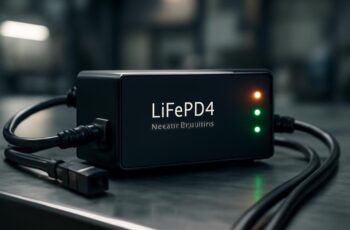
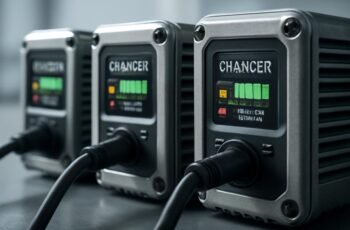
Studies show that proper multi-stage charging can extend LiFePO4 battery lifespan by up to 30%. This precise control over voltage, current, and temperature minimizes stress on the cells, ensuring safer and more efficient operation. Understanding how these chargers adapt through different phases—bulk, absorption, and float—is critical for optimizing performance and longevity. Exploring the intricacies of these stages reveals why selecting the right charger is essential for your system’s reliability and efficiency.
Key Takeaways
- Multi-stage LiFePO4 chargers optimize battery lifespan through controlled bulk, absorption, and float phases.
- They incorporate safety features like overvoltage, undervoltage, and temperature protections to ensure safe charging.
- Proper calibration and correct wiring are essential for accurate voltage regulation and system reliability.
- Advanced chargers use adaptive algorithms and real-time diagnostics for efficient, intelligent charging management.
- Compatibility with battery specifications and adherence to safety standards are critical for effective LiFePO4 charging.
How Do Multi-Stage LiFePO4 Battery Chargers Work?
Multi-stage LiFePO4 battery chargers operate through a series of precisely controlled phases that optimize charging efficiency and battery longevity. These distinct topics include bulk, absorption, and float stages, each serving a specific purpose in maintaining battery health. During the bulk phase, the charger supplies maximum current until reaching a set voltage threshold, prioritizing rapid charge. The absorption phase then reduces current, allowing voltage stabilization and preventing overcharge, which directly relates to battery safety. Finally, the float stage maintains the battery at a lower voltage to prevent over-discharge while preserving capacity. This controlled, multi-phase approach ensures safety by minimizing risks of thermal runaway and overvoltage, while also extending battery life through optimized charging parameters. Overall, these phases work in harmony to deliver a precise, safe, and efficient charging process.
Why Use Multi-Stage Charging for LiFePO4 Batteries?
Using a multi-stage charging approach for LiFePO4 batteries considerably enhances their overall performance and lifespan. This method optimizes charging efficiency by precisely controlling voltage and current during each phase, reducing stress on the battery cells. It also ensures adherence to safety protocols, minimizing risks like overcharging or thermal runaway. The process involves various stages, each designed to optimize capacity and longevity:
| Stage | Purpose |
|---|---|
| Bulk | Rapid initial charging |
| Absorption | Voltage stabilization and full charge |
| Float | Maintaining full charge safely |
| Equalization | Balancing cell voltages |
| Rest | Cell stabilization and safety |
This structured approach improves efficiency and safety, extending battery life and maintaining optimal performance.
The Stages of LiFePO4 Battery Charging Explained
Have you ever wondered how a LiFePO4 battery achieves a full, safe charge while maintaining optimal health? The charging process involves distinct stages: bulk, absorption, and float. During the bulk stage, the charger supplies maximum current, rapidly reaching the battery’s voltage threshold. In edge storage applications, this stage ensures swift energy capture, critical for efficient solar pairing. The absorption phase follows, where current tapers as voltage stabilizes, allowing the battery to safely complete its charge without stress. Finally, the float stage maintains the full charge level with minimal current, preserving battery health over time. Multi-stage chargers precisely control these phases, preventing overcharge and extending lifespan. This structured process ensures LiFePO4 batteries stay healthy, especially in setups involving solar pairing, where consistent and safe charging is essential.
Key Features to Look for in a Multi-Stage LiFePO4 Charger
What specific features should we prioritize when selecting a LiFePO4 charger with multi-stage capabilities? First, the charger must incorporate adaptive charge algorithms to optimize energy storage efficiency and prolong battery lifespan. Precise voltage and current regulation are essential to prevent overcharging and ensure safe operation. Additionally, integration of temperature compensation improves reliability, especially in diverse environmental conditions. Market adoption influences the availability of advanced safety features and compatibility standards, which are critical for scalable energy storage solutions. A charger with real-time monitoring and diagnostics supports maintenance and performance optimization. Ultimately, these features ensure efficient energy storage, promote safety, and enhance market acceptance of multi-stage LiFePO4 systems, making them a reliable choice for various applications.
How to Choose the Right Charger for Your Lithium Iron Phosphate Battery
Selecting the right charger requires evaluating compatibility with your battery’s specifications to ensure proper voltage and current. We also consider charging speed and efficiency to optimize performance without compromising safety, while safety and protection features are essential to prevent overcharging or damage. By systematically evaluating these points, you can identify a charger that maximizes lifespan and reliability for your LiFePO4 battery.
Compatibility With Battery Specs
Choosing the appropriate charger for your lithium iron phosphate (LiFePO4) battery requires careful attention to its specific electrical characteristics. Compatibility testing ensures the charger’s voltage and current parameters align with the battery’s specifications, safeguarding battery safety. Mismatched chargers can induce thermal runaway or capacity degradation. To optimize safety and performance, verify the following parameters:
| Parameter | Battery Specification | Charger Specification |
|---|---|---|
| Nominal Voltage | 3.2V – 3.3V per cell | 3.65V – 3.65V per cell |
| Max Charge Current | Based on capacity (C-rate) | Within recommended limits |
| Cut-off Voltage | 3.65V per cell | 3.65V per cell |
Ensuring these specifications match minimizes risks, enhances longevity, and maintains reliable operation.
Charging Speed and Efficiency
Optimizing charging speed and efficiency hinges on matching your LiFePO4 battery’s requirements with an appropriately rated charger. Proper alignment ensures maximum charging efficiency while maintaining lithium safety. A charger with insufficient current capacity prolongs charging times and risks incomplete charge cycles, whereas an oversized charger can generate excess heat and compromise battery longevity. Precise current regulation during multi-stage charging enhances efficiency and safeguards lithium safety by preventing overcurrent conditions. Additionally, selecting a charger with advanced control algorithms optimizes charging speed without sacrificing safety or longevity. Ensuring compatibility with your battery’s specifications is crucial for achieving optimal charging performance, reducing energy waste, and extending battery life. Accurate matching of charger ratings to battery needs ultimately delivers a safer, more efficient charging process.
Safety and Protection Features
Ensuring the safety and protection of your LiFePO4 battery during charging requires careful consideration of the charger’s built-in safety features. Critical safety protocols include overvoltage, undervoltage, and overcurrent protection, which prevent damage by maintaining optimal voltage and current levels. A charger with robust temperature monitoring safeguards against thermal runaway, preserving data integrity and battery longevity. Precise cutoff mechanisms are essential for stopping charging at the correct thresholds, avoiding overcharging risks. Additionally, safety features like reverse polarity protection and automatic shutoff enhance operational reliability. When selecting a charger, verify it incorporates comprehensive safety protocols aligned with your application’s demands. This focus on safety and protection ensures your battery maintains high data integrity, prolongs lifespan, and operates safely under varying conditions.
Benefits of Multi-Stage Charging for Battery Longevity
Multi-stage charging considerably extends the life of LiFePO4 batteries by carefully managing the charging process through distinct phases. Idea one involves optimizing the bulk, absorption, and float stages to prevent overcharging and minimize thermal stress, which directly impacts battery longevity. Idea two emphasizes precise control over charge rates, ensuring the battery remains within safe voltage thresholds, reducing degradation over time. This structured approach mitigates capacity loss caused by partial cycling and high current stress, maintaining cell integrity. By tailoring each charging phase, multi-stage chargers enhance overall battery health and cycle life, resulting in improved performance and reduced replacement costs. Ultimately, this method provides a scientifically grounded strategy that prolongs battery lifespan while maintaining optimal operational efficiency.
Common Issues and Troubleshooting Multi-Stage LiFePO4 Chargers
Addressing common issues in multi-stage LiFePO4 chargers requires careful attention to overcharging prevention techniques, voltage calibration accuracy, and connection integrity. Missteps in any of these areas can lead to improper charging cycles or system faults, compromising battery longevity and safety. We will examine precise troubleshooting strategies to identify and resolve these technical challenges effectively.
Overcharging Prevention Techniques
Overcharging remains a critical concern in the operation of LiFePO4 battery chargers, as it can lead to reduced battery lifespan, safety hazards, and diminished performance. Effective overcharge prevention techniques include implementing precise charge termination methods, such as current limit controls and temperature sensing, which detect the end-of-charge state accurately. Relying on irrelevant topics like stray discussion about voltage thresholds can divert focus from core safety measures. Multi-stage chargers employ a combination of bulk, absorption, and float stages, each with built-in safeguards to prevent overvoltage conditions. Additionally, integrating hardware-based cutoffs and smart control algorithms ensures overcharging is swiftly halted. These measures collectively enhance charger reliability, prevent thermal runaway, and extend battery life, emphasizing the importance of rigorous overcharge management in advanced LiFePO4 charging systems.
Voltage Calibration Errors
Voltage calibration accuracy is fundamental to the proper functioning of LiFePO4 battery chargers, especially in multi-stage systems where each stage relies on precise voltage thresholds. Calibration drift over time can cause deviations beyond the specified voltage tolerance, leading to misinterpretation of charge states. Such errors may result in undercharging or overcharging, impacting battery lifespan and safety. To troubleshoot, consider these factors:
- Regularly verify calibration against a known voltage reference
- Monitor for signs of calibration drift, especially after firmware updates or component replacements
- Adjust calibration settings to account for observed voltage deviations
Maintaining strict voltage calibration ensures each stage functions accurately, preventing issues caused by voltage tolerance oversights and ensuring optimal charging performance.
Connection and Wiring Issues
Have you verified that all wiring connections are secure and correctly configured? Proper wiring is critical for multi-stage LiFePO4 chargers, as loose or incorrect connections can cause inaccurate readings, improper charging, or damage. We recommend systematically checking each connection against the manufacturer’s wiring diagram, ensuring polarity is correct and terminals are tight. An irrelevant topic, such as the charger’s physical placement, might seem unrelated but can impact wiring integrity through vibration or exposure to elements. Additionally, a random idea like using incompatible wire gauges can lead to voltage drops or overheating. Troubleshooting wiring issues requires precision; ignoring even minor inconsistencies can compromise the entire charging process, leading to inefficient operation or potential safety hazards.
Future Trends in LiFePO4 Battery Charging Technology
What emerging advancements will shape the future of LiFePO₄ battery charging technology? Although insufficient data limits comprehensive predictions, several trends are promising. We expect innovations in adaptive charging algorithms that optimize lifespan and efficiency, reducing degradation. Integration of smart diagnostics will enable real-time monitoring, improving safety and performance, even in complex multi-stage chargers. Additionally, advancements may include the development of standardized communication protocols, facilitating interoperability across unrelated topics like renewable energy systems and electric vehicles. These trends will likely lead to more intelligent, efficient, and reliable LiFePO₄ charging solutions, addressing current limitations. As technology advances, ongoing research will clarify these pathways, ultimately shaping a future where multi-stage chargers are more sophisticated yet easier to implement.
Frequently Asked Questions
Can Multi-Stage Chargers Be Used With Other Battery Chemistries?
We understand charger compatibility depends on matching the charger’s settings to the specific battery chemistry limits. Multi-stage chargers often aren’t suitable for other chemistries, as improper voltage or current regulation can damage batteries and compromise safety.
What Safety Features Are Included in Multi-Stage Lifepo4 Chargers?
Like a vigilant guardian, our multi-stage Lifepo4 chargers include safety features such as over-voltage protection, temperature monitoring, and short-circuit prevention, ensuring durability, efficiency, and seamless solar compatibility while minimizing maintenance and optimizing safety monitoring.
How Long Does a Typical Multi-Stage Charging Cycle Take?
A typical multi-stage Lifepo4 charging cycle lasts around 4 to 8 hours; longer cycles enhance efficiency but involve tradeoffs like increased energy use, requiring us to balance charging speed and overall system performance carefully.
Are Multi-Stage Chargers Compatible With Solar Power Systems?
We find that multi-stage chargers are highly compatible with solar power systems, especially those with solar compatibility features and auto disconnect functions, ensuring efficient, safe charging and preventing overcharging, which optimizes battery life and system performance.
What Maintenance Is Required for Multi-Stage Lifepo4 Chargers?
We perform regular maintenance checks on multi-stage Lifepo4 chargers, inspecting connections, cooling systems, and firmware updates to ensure optimal performance. Consistent maintenance guarantees long-term reliability and prevents operational failures, maximizing system lifespan and efficiency.
Conclusion
As we explore the intricacies of multi-stage LiFePO4 charging, it becomes clear that mastering this technology unlocks longer battery life and enhanced safety. But as advancements continue, questions about optimal configurations and future innovations arise. Can these sophisticated chargers keep pace with evolving energy demands? Staying informed and vigilant will be key. The next breakthrough could redefine how we power our devices—are you prepared to embrace the future of lithium iron phosphate charging?