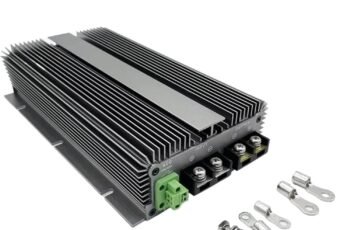
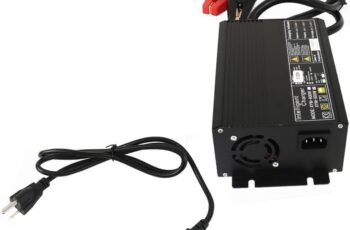
KAISAL 48V 15A Lithium Battery Charger: Product Overview
A 15A charger with vehicle-ready M8 terminals sounds practical, but only if the battery chemistry and charging voltage match. The KAISAL 48V LiFePO4 charger is designed for 48V batteries with a nominal 51.2V system voltage, and its direct terminal connection makes more sense for a mounted battery than a small portable pack. Our early view is cautious but positive: the feature set is useful for the right battery, although the listing leaves several ownership details unanswered.
This is a dedicated 48V LiFePO4 charger for LiFePO4 batteries, not a universal charger for every battery labelled 48V. Ordinary 48V lithium-ion packs, 13S e-bike batteries, and lead-acid batteries can require different final charging voltages, charging profiles, connectors, and safety requirements. Matching the battery manual is essential before connecting it.
The stated applications include golf carts, forklifts, floor scrubbers, lawn mowers, cars, boats, RVs, solar systems, off-grid installations, scissor lifts, and electric outboards. That range reflects the built-in O-shaped M8 terminals and IP67 enclosure rather than a plug-and-play e-bike design. We would treat the KAISAL as a vehicle or equipment charger first.
We assess the 48V LiFePO4 charger below by its stated specifications, compatibility, charging controls, status indicators, construction, available customer-review evidence, and alternatives. No independent test result, rating, or review count was supplied, so we will not invent one.

Key Specifications and Compatibility Checks
The most important specification is not the 15A figure; it is the battery match. The KAISAL 48V LiFePO4 charger targets 48V LiFePO4 batteries commonly described as 51.2V systems. That wording refers to nominal system voltage, not necessarily the charger’s final output voltage, which should always be confirmed in the battery documentation.
| Specification | Stated detail |
|---|---|
| Battery chemistry | LiFePO4 lithium |
| Voltage class | 48V nominal; compatible with 51.2V systems |
| Charging current | 15A |
| Efficiency | Up to 94% claimed |
| Charging method | Three-stage charging |
| Enclosure | IP67 |
| Cooling | Built-in fan |
| Connection | O-shaped M8 terminals |
A nominal 48V LiFePO4 battery is built from cells whose combined operating system is commonly identified as 51.2V. That does not make every 48V lithium battery interchangeable. The KAISAL 48V LiFePO4 charger should not be treated as suitable for 48V lithium-ion, 13S, lead-acid, or other packs with a different charge profile.
Before buying this 48V LiFePO4 charger, we would complete six checks: confirm LiFePO4 chemistry, verify nominal voltage, check terminal polarity, confirm that the battery uses M8 studs, review BMS charging requirements, and confirm the charger’s input-power requirements. The M8 O-shaped terminals are intended for a direct, secure connection to a battery installed in a vehicle or machine, not necessarily for a universal socket.
Our practical recommendation is to photograph the battery label and compare every charging detail with the battery manual. If the battery uses a proprietary plug, barrel connector, or a charger supplied by the equipment maker, an adapter should not be assumed safe simply because both products mention 48V.
48V LiFePO4 Charger Charging Performance and Three-Stage Control
The advertised output is 15A, and the manufacturer estimates about 6.5 hours to charge a 100Ah LiFePO4 battery. It also claims that this saves approximately 3.5 hours compared with a 10A charger. Those figures are manufacturer estimates rather than independently verified measurements, and actual charging time will change with starting state of charge, battery condition, temperature, and BMS limits.
For a 100Ah battery, the 48V LiFePO4 charger should be understood as a relatively high-current option within this product category. The first stage supplies higher current while the battery accepts it. The second stage holds the charging voltage while current gradually tapers, and the final stage uses a lower current before the charger shuts down when the battery is full.
That taper matters because forcing maximum current into a nearly full battery is not the normal way to finish a LiFePO4 charge. Automatic current reduction can help limit stress and heat, but it does not replace the battery’s own BMS or the charging instructions supplied with the pack. We would not leave an unfamiliar battery unattended during its first cycle.
To check whether the 48V LiFePO4 charger performs close to the advertised estimate, record the battery’s starting percentage, charging start time, ambient temperature, and end time for the first several cycles. Also note whether the current visibly tapers near full charge and whether the unit shuts down rather than continuing indefinitely.
The claimed efficiency is up to 94%. In practice, wall-power consumption, heat, and charging speed can differ from nominal figures because conversion losses, cable resistance, temperature, and battery acceptance all affect the result.


Status Lights, 0V Activation, and Battery Protection
The indicator system is unusually detailed for a charger in this format. Green steady means no-load, standby, or 0V wake-up mode; red fast flash indicates precharging from 0% to 19%; red flash indicates constant-current charging from 20% to 79%; yellow flash indicates constant-voltage charging from 80% to 99%; green flash represents small-current charging at approximately 100%; and green steady means fully charged.
With the 48V LiFePO4 charger, these stages give us a simple way to distinguish active charging from standby without relying only on a voltage meter. A flashing colour indicates a charging phase, while a steady green light can mean either a full battery or a no-load condition, so the battery connection and timing still need to be considered.
The advertised 0V activation function is intended for a low-voltage LiFePO4 battery whose BMS has disconnected the pack after excessive discharge. The 48V LiFePO4 charger may wake the BMS and begin charging, but activation is not the same as repairing failed cells, a damaged pack, or a defective BMS.
We would use a cautious recovery sequence:
- Disconnect loads and inspect the battery, cables, and terminals.
- Confirm the chemistry, nominal voltage, and polarity.
- Connect the terminals securely and observe the first minutes of charging.
- Stop immediately if there is unusual heat, odour, sparking, swelling, leakage, or repeated protection-mode entry.
CPU monitoring, current reduction, overcharge prevention, and automatic shutdown are charger safeguards. They should be viewed alongside, not instead of, the battery’s own BMS protection. A swollen, overheated, leaking, or physically damaged battery should not be revived with this feature.
IP67 Construction, Cooling, and Outdoor Installation
The one-piece sealed die-cast aluminium case and stated IP67 rating suit equipment that may encounter dust, splashes, and outdoor conditions. IP67 generally means dust protection and temporary immersion under defined test conditions; it does not mean unlimited exposure to rain, salt water, pressure washing, or operation while submerged.
The 48V LiFePO4 charger includes a built-in cooling fan, and the manufacturer says its surrounding eddy-current design improves heat dissipation. That may help during a 15A charging session, but airflow still matters. We would keep the case clear of insulation, mud, standing water, and enclosed spaces that trap heat.
Potential applications include golf carts, boats, RVs, forklifts, lawn equipment, and off-grid systems. For marine or dusty installations, the connection points deserve as much attention as the enclosure: keep terminals dry and clean, protect them from corrosion, and provide strain relief so vibration does not pull on the studs.
Our setup checklist is straightforward:
- Mount the charger securely with airflow around the case.
- Keep vents and the fan path unobstructed.
- Use dry, clean terminals and confirm polarity.
- Prevent cable strain and avoid placing the unit on wet ground.
- Inspect the case, connections, and heat after the first charging cycle.
The product description does not provide dimensions, input-voltage range, cable length, noise level, certification details, or warranty terms. Those omissions matter for a permanent installation. We would confirm them with the seller before fitting the 48V LiFePO4 charger inside a vehicle, boat, workshop, or solar enclosure.

What Customers Are Saying
No customer-review ratings, review count, review dates, or verified-buyer quotations were included in the supplied product data. That means we cannot honestly claim that many buyers praised the charging speed, reported successful 0V activation, or confirmed long-term durability. The listed price of £129 is also not evidence of customer satisfaction or ownership value.
For the 48V LiFePO4 charger, the most useful customer evidence would concern 100Ah-class batteries, real charging times, whether the 15A output is sustained, and whether the unit tapers and shuts down correctly. We would give more weight to repeated reports with battery capacity, starting charge level, temperature, and elapsed time than to a short comment saying only that it works.
We would also separate successful BMS wake-up from claims of permanent battery repair. A report that a low-voltage pack resumed charging demonstrates activation in that case; it does not prove that failed cells or a defective battery can be restored.
Reviews should clarify whether the three-colour light is easy to read, whether flashing patterns remain visible outside, and whether green standby is confused with a full-charge indication. Other worthwhile themes include fan noise, operating temperature, case sealing, terminal quality, cable length, and installation convenience.
Compatibility reports deserve particular scrutiny. Comments about M8 fit, polarity, plug adapters, or use with another 48V system may reveal more than a star rating. Until a dated review set and quantity are available, we should treat the customer-feedback picture as unverified rather than filling the gap with invented patterns.
How the KAISAL Charger Compares With Alternatives
The KAISAL 48V LiFePO4 charger occupies a different category from the EPOWREY AMP Volt Golf Cart Battery Charger. EPOWREY is presented as a golf-cart charger for lead-acid batteries with a Club Car 3-pin round plug, whereas KAISAL is specified for LiFePO4 batteries and uses direct O-shaped M8 terminals. Similar amperage does not make those products interchangeable.
The EVAPLUS 54.6V Safe Charger for 48V Lithium Batteries is another important contrast. Its 54.6V charging output and small DC connector are associated with 48V 13S lithium-ion applications such as electric bikes and scooters. The KAISAL 48V LiFePO4 charger is intended for 48V or 51.2V LiFePO4 systems with M8 terminal connections. A voltage label alone cannot establish compatibility.
For a permanently installed vehicle or equipment battery, the 48V LiFePO4 charger has several stated advantages: 15A output, direct M8 connection, IP67 construction, a cooling fan, three-stage control, and 0V activation. An alternative may be better for an e-bike with a barrel connector, a lead-acid golf cart, or a battery requiring a certified model-specific interface.
We would compare products in this order: chemistry, final charging voltage, current, connector and polarity, enclosure rating, protection functions, certification, warranty, and total price. Amperage should come later. A faster charger with the wrong charge profile is not an upgrade; it is a compatibility problem.

Who Should Consider This 48V LiFePO4 Charger?
The best-fit shopper has a 48V or 51.2V LiFePO4 battery, accessible M8 terminals, and a reason to want a 15A charging rate. That could be a golf-cart owner, boat owner, forklift operator, RV user, workshop technician, or off-grid system owner who needs direct connection rather than an e-bike-style plug.
A 100Ah battery owner may find the stated approximately 6.5-hour charging estimate useful when equipment must return to service on the same day. The claimed time advantage over a 10A charger is approximately 3.5 hours, but the real result depends on battery state, temperature, BMS behaviour, and the taper near full charge.
The 48V LiFePO4 charger may also suit dusty work areas and outdoor equipment because the listing specifies an IP67 case and built-in fan. Still, we would not choose it for lead-acid chemistry, ordinary lithium-ion, incompatible terminal hardware, or a compact e-bike connector.
Before ordering, we would complete this checklist:
- Photograph the battery label and confirm LiFePO4 chemistry.
- Verify nominal voltage and the battery manual’s recommended charging current.
- Check polarity and confirm that the M8 terminals physically fit.
- Confirm available input power and installation airflow.
- Review warranty, certification, cable details, and return information.
That process keeps suitability separate from the final buying decision. The charger’s strengths are meaningful, but only when the battery and installation match them exactly.

Pros and Cons
Pros
- 15A charging output with a manufacturer-estimated 6.5-hour charge for a 100Ah LiFePO4 battery
- Direct O-shaped M8 terminals suited to vehicle and equipment-mounted batteries
- Three-stage charging, automatic current reduction, 0V activation, and automatic shutdown
- Stated IP67 sealed die-cast aluminium enclosure with built-in cooling fan
- Designed for several LiFePO4 applications including golf carts, boats, RVs, forklifts, and off-grid systems
Cons
- Not a universal 48V charger and unsuitable by default for lead-acid or ordinary 48V lithium-ion batteries
- The listing does not provide dimensions, input-voltage range, cable length, noise level, certifications, or warranty terms
- The USD0.00 displayed price requires confirmation and cannot establish actual purchase value
- No customer rating, review count, review date range, or verified-buyer test results were supplied
- Direct M8 terminals may be inconvenient for batteries using proprietary plugs or barrel connectors
Final Verdict
Key Takeaways
- The charger is designed for 48V or 51.2V LiFePO4 systems, not all batteries marketed as 48V.
- Its 15A output, three-stage control, direct M8 terminals, fan, and stated IP67 enclosure suit vehicle and equipment installations.
- The approximately 6.5-hour 100Ah charging estimate and up-to-94% efficiency claim come from the manufacturer and were not independently verified.
- The listing lacks review statistics, dimensions, input-voltage range, certification details, and warranty terms, so buyers should confirm those points before installation.
Frequently Asked Questions
Is the KAISAL charger suitable for every 48V battery?
No. It is specified for 48V or 51.2V LiFePO4 batteries. It should not automatically be used with lead-acid, 48V lithium-ion, 13S e-bike packs, or batteries requiring a different charging voltage or connector.
What does the 0V activation function do?
It is intended to wake a low-voltage LiFePO4 battery after its BMS has disconnected the pack. It does not repair failed cells, swelling, leakage, physical damage, or a defective BMS.
How long should it take to charge a 100Ah battery?
The manufacturer estimates approximately 6.5 hours with the 15A charger. Actual time depends on starting charge level, battery condition, temperature, BMS limits, and the final constant-voltage taper.
Are customer ratings and review counts available for this assessment?
The supplied product data does not include a rating, review count, dated review range, or verified-buyer quotations. We therefore cannot claim a specific customer satisfaction level or independently confirmed performance result.
Disclosure: As an Amazon Associate, I earn from qualifying purchases.