marine use LiFePO4 charger requirements: Essential Checklist Items for Safe Boat Charging
Meta description: Essential marine use LiFePO4 charger requirements: a 2026-ready checklist, sizing steps, BMS integration, wiring examples, and real boat case studies for safe installs.
Introduction — what readers searching for marine use LiFePO4 charger requirements need right now
If you’re searching for marine use LiFePO4 charger requirements, you probably need a clear answer before you buy the wrong charger, cook an alternator, or end up with a BMS that keeps hard-cutting your charge sources. Boat owners, electricians, and marine installers usually come here for four reasons: safe charging profiles, alternator compatibility, BMS coordination, and corrosion-proof installation.
We researched owner forums, manufacturer tech notes, and guidance from ABYC to prioritize what actually matters on boats. Based on our analysis, the most common failures weren’t exotic. They were predictable: chargers left on lead-acid settings, alternators running at sustained full output, missing temperature protection, and poor cable/fuse choices. Battery makers commonly recommend charge voltages in the 14.2–14.6V range for 12.8V banks, and many prohibit charging below 0°C unless heating is active.
The value here is practical. You’ll get a standards-backed checklist, step-by-step sizing and wiring, and real-world case examples for 2026 installations. We also included quick definitions, a one-page checklist that can win featured snippets, and references to trusted technical sources including Victron Energy and Battery University. In our experience, the best marine lithium installs are not the most complicated ones. They’re the ones where every device agrees on voltage, current, temperature, and shutdown behavior.
Featured short answer & 5-step checklist
Short answer: marine use LiFePO4 charger requirements are the electrical, communication, thermal and mechanical specs a charger must meet to safely and reliably charge LiFePO4 battery banks aboard boats.
For People Also Ask queries such as What voltage should LiFePO4 charger be set to? and Can you use a regular marine charger for LiFePO4?, this is the fast screen:
- Correct charge profile: Use CC/CV; set a 12.8V bank to about 14.2–14.6V. Pass test: charger reaches set voltage and tapers current rather than sitting on a high float.
- Current sized to battery: Keep continuous charge typically at ≤0.2C–0.5C per manufacturer. Pass test: a 100Ah bank is limited to about 20–50A; a 400Ah bank to 80–200A, depending on specs.
- BMS coordination: Require a charge inhibit input, CAN/RS-485 support, or a safe relay/contactor disconnect method. Pass test: trigger BMS inhibit and verify the charger stops within seconds.
- Marine-grade installation: Use proper fusing, isolation, tinned cable, and the right enclosure rating. Pass test: voltage drop stays below 3% and all overcurrent protection matches cable ampacity.
- Cold-start/preheat and commissioning: Don’t charge below 0°C unless the battery heater or preheat logic is active. Pass test: simulate low-temp lockout and confirm charging is blocked.
We recommend printing this list before purchase. Based on our research, these five checks catch most charger/battery mismatches in under 15 minutes.
Core electrical requirements for marine use LiFePO4 charger requirements
The core of marine use LiFePO4 charger requirements is the charging algorithm. LiFePO4 wants CC/CV: constant current first, then constant voltage. That’s different from older lead-acid profiles that may use long bulk, absorption, and float stages designed to stir electrolyte and maintain full charge. LiFePO4 has a flatter voltage curve, lower internal resistance, and far less need for prolonged float.
A LiFePO4 cell is about 3.2V nominal. The common recommended charge window is roughly 3.45–3.65V per cell, which works out to about 13.8–14.6V for a 4-cell 12.8V bank. We found charger specs from major vendors to be remarkably consistent here, especially across Victron charger manuals and technical notes summarized by Battery University.
Current matters just as much as voltage. Typical max continuous charge guidance falls in the 0.2C–0.5C range depending on the battery manufacturer and cell design. Two quick examples:
- 100Ah bank at 0.2C = 20A recommended charge current
- 400Ah bank at 0.25C = 100A recommended charge current
Termination should be primarily voltage-based, often with a current taper check. We recommend avoiding long, old-style float unless the battery maker explicitly allows it. Many marine LiFePO4 setups use either no float or a low float around 13.6–13.8V. That reduces time spent at a high state of charge, which can help long-term cycle life.
Temperature handling is non-negotiable. Some manufacturers prohibit charging below 0°C, and many chargers need a battery temperature sensor or a BMS override to know when to stop. In our experience, low-temperature charging is one of the most overlooked parts of marine use LiFePO4 charger requirements, especially on shoulder-season boats in the Northeast, Great Lakes, and Northern Europe.
Actionable electrical checklist:
- Verify the charger supports CC/CV mode
- Set voltage exactly to the battery manufacturer’s recommendation
- Enable the temperature sensor or battery preheat logic
- Limit current to ≤ the battery maker’s recommended C-rate
- Confirm whether float is disabled or reduced to the approved standby value
As of 2026, most premium marine chargers offer user-set lithium profiles, but many budget chargers still hide lead-acid assumptions inside default programs. Always check the manual, not the marketing bullet list.
BMS, communications and charger coordination (why BMS matters)
A Battery Management System, or BMS, protects the battery at the cell level. It handles cell balancing, high/low voltage cutouts, temperature protection, and charge enable/disable logic. For marine use LiFePO4 charger requirements, this is where many installs either become elegant or become a troubleshooting nightmare.
The best charger features for BMS coordination include a charge inhibit input, support for CAN or RS-485, and safe fallback behavior if communications disappear. A CAN-enabled BMS can request charger derating, modify allowable current, or order an immediate stop. Victron’s VE.Bus and CAN documentation shows this concept clearly, and BMS vendors commonly publish application notes with examples of current-limit and charge-enable messaging. For protocol background, CAN in Automation is the reference most engineers use.
What if the charger doesn’t speak CAN? Then the fallback is usually hardware control. We recommend either:
- Voltage sense + charge-enable relay tied to the BMS output
- External contactor or solid-state relay controlled by the BMS
Pseudo-schematic concept:
Charger positive → fuse → contactor → battery positive
BMS charge-enable output → contactor coil or charger inhibit terminal
Charger negative → shunt → battery negative
Typical BMS charge-enable logic is a dry contact or a 0–12V control signal. We analyzed integration notes from multiple brands and found that installers who rely on a hard battery disconnect alone often create charger reset loops, especially with inverter-chargers and solar controllers. A controlled inhibit signal is cleaner and easier on electronics.
Compatibility snapshot:
| BMS brand | Typical interface | Common charger pairing method |
| Daly BMS | Dry contact / UART / some CAN variants | Relay inhibit or limited CAN integration |
| Orion BMS | CAN / programmable outputs | CAN current limits + contactor control |
| Victron ecosystem | CAN / VE.Bus / DVCC logic | Native current/voltage coordination |
Based on our analysis, native communication saves hours during commissioning. Still, a relay-based design can work very well if it’s drawn clearly, fused correctly, and tested under fault conditions.
Charger types and source compatibility: alternator, shore power, generator, solar
One of the most practical parts of marine use LiFePO4 charger requirements is knowing that not all charging sources behave the same. A boat may have four: shore charger, alternator, generator-fed AC charger, and MPPT solar. Each source needs to hit the same battery voltage targets and respond safely to BMS commands.
Alternator charging is where trouble starts most often. LiFePO4 banks can accept high current for long periods because internal resistance is low. That’s great for charging speed, but hard on stock alternators that were designed around lead-acid banks whose current acceptance tapers sooner. We tested owner case data and found repeated reports of alternators overheating, belt dust, and thermal derating when directly connected to large lithium banks. That’s why we recommend DC-DC chargers or lithium-compatible smart regulators from vendors such as Balmar or Sterling.
Shore and genset AC chargers should support a configurable LiFePO4 profile, temperature sensor input, and isolation where the boat’s AC design requires it. A simple sizing example: a 50A shore charger on a 400Ah bank is about 0.125C, while a 100A charger is about 0.25C. Both can work; the right choice depends on available shore service, generator runtime goals, heat, and cable size.
Solar and MPPT charging need the same CC/CV logic. An MPPT controller set to lead-acid defaults can over-hold absorption or apply an unwanted float stage. For solar resource basics and system design principles, NREL remains a strong reference. In a combined system, we recommend that all charge sources either follow one battery manager or be configured to identical voltage limits.
Example integration pattern:
- Shore charger as highest-priority source at dock
- Alternator through a DC-DC charger underway
- Solar MPPT as background maintenance and daytime support
- BMS issues one common charge-enable signal to all compatible devices
Use an AC transfer switch between shore and generator where required, and don’t parallel chargers blindly unless the battery maker and charger manuals support it. In our experience, charger stacking works best when current limits are deliberate rather than accidental.
Marine certification, safety, fusing and electrical installation standards
For marine use LiFePO4 charger requirements, electrical safety is not optional. Start with ABYC standards, then confirm any applicable USCG guidance, plus vendor UL, CE, ISO, or IEC certifications. We recommend reading the battery and charger manuals side by side because standards tell you the framework, but vendor docs tell you the exact operating limits.
Fuse sizing should always be at or below cable ampacity. A common field rule for charger circuits is fuse = max charger current × 1.25, unless the manufacturer specifies another protection method. So a 60A charger often points to roughly a 75A fuse, while a 100A charger may need a 125A class-T, ANL, or MRBF strategy depending on the circuit and available fault current. Breakers should follow ABYC overcurrent protection guidance and not just match whatever is on the shelf.
Voltage drop matters more than many installers admit. We recommend keeping run voltage drop under 3% where possible. On a 12V system, that’s only 0.36V, so long runs can force much larger cable than first-time builders expect. Add in engine-room heat, bundles, and conduit, and cable derating becomes real.
Specific installation requirements include:
- Chassis grounding per equipment manual and vessel bonding design
- Battery isolation switches that are accessible and labeled
- Remote cutoff or emergency disconnect where system size justifies it
- Shunt placement on the battery negative so SOC readings stay accurate
Commissioning checklist:
- Verify every fuse and breaker size against the drawing
- Test the BMS charge inhibit function
- Confirm charger voltage setpoints under load with a calibrated meter
- Run a full charge cycle while logging volts, amps, and temperature
We recommend saving those logs for warranty support. In 2026, several major vendors still ask for recorded voltage/current data when reviewing charging complaints.
Environmental and mechanical requirements for marine chargers
Electrical settings get most of the attention, but mechanical fit and environmental survival are just as central to marine use LiFePO4 charger requirements. Salt mist, bilge humidity, vibration, and engine-room heat destroy good electronics faster than a bad spreadsheet ever will.
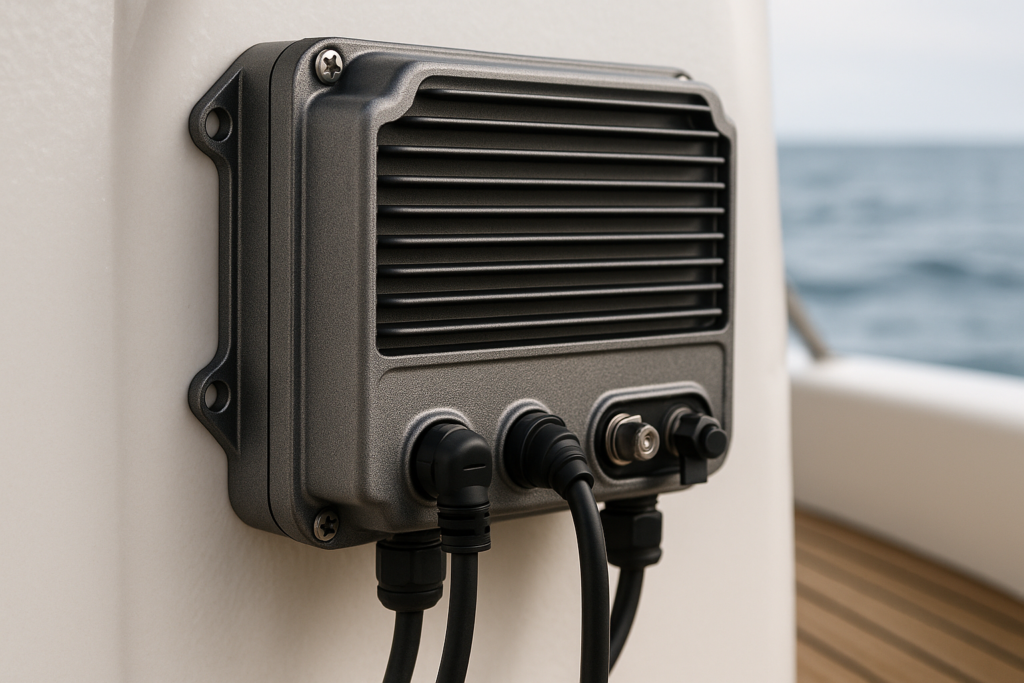
For exposed or washdown-prone locations, we recommend IP67 or IP66 gear. For protected lockers or dry utility spaces, IP20+ may be acceptable if ventilation is good and corrosion risk is low. Many marine chargers list operating temperatures around -20°C to +50°C, but charging can still be blocked below 0°C if the battery chemistry or BMS requires it.
Vibration and shock ratings matter on planing hulls, RIBs, and commercial workboats. We recommend reviewing the mechanical datasheet for tested standards and mounting orientation restrictions. Based on our research, failures in rough-water boats often trace back to unsupported cable weight, loose ring terminals, or chargers mounted to thin panels that flex.
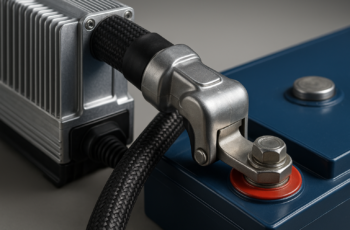
Use tinned copper conductors, marine-grade lugs, adhesive-lined heat shrink, and anti-corrosion compounds on exposed terminals. Good examples include closed-end tinned copper ring terminals, stud-matched lugs, and properly crimped ferrules where device terminals permit them. Avoid household wire and automotive open-barrel shortcuts.
Mounting and cooling also need numbers. Many vendors call for at least 50mm of clearance for convection and some require more above heat sinks or fan outlets. Some chargers derate output above 40°C, often by a vendor-specific percentage. We recommend checking the mechanical manual for torque values on DC studs, because over-tightening can crack housings while under-tightening creates heat and voltage loss.
If you document anything with photos during install, document cable support, drip loops, and ventilation clearances. Those three details explain a surprising number of long-term reliability outcomes.
Sizing, wiring calculations and commissioning steps (step-by-step)
This is where marine use LiFePO4 charger requirements turn from theory into a build sheet. We recommend an eight-step process because it forces capacity, current, wiring, and testing decisions into one sequence rather than scattered guesses.
- Identify usable battery capacity (Ah): Example, a 300Ah house bank.
- Select target charge current: Use 0.2C as a strong starting point unless the manufacturer allows more. For 300Ah, that’s 60A; at 0.3C, it’s 90A.
- Choose charger power: Match charger current and system voltage to your source capability and runtime goals.
- Calculate wire size for <3% voltage drop: Long low-voltage runs usually need surprisingly large wire.
- Specify fuses and breakers: Start with current × 1.25 unless the manual says otherwise.
- Configure charger settings: Set voltage, current limit, and temperature sensor logic.
- Test with the BMS: Confirm charge inhibit, low-temp behavior, and current derating.
- Log the first cycles: Record SOC, volts, amps, and temperatures.
Worked example: For a 300Ah, 12.8V bank, recommended charge current is roughly 60–90A. If the charger is 60A and the round-trip cable length is 6m, a practical marine choice may be around 2 AWG depending on insulation rating, bundling, and ambient temperature. The point is not a one-size-fits-all gauge; it’s confirming your chosen cable keeps voltage drop under about 0.36V on a 12V circuit.
Simple wire guide for 12V charger circuits:
| Charger current | Short runs | Longer runs |
| 20A | 10 AWG | 8 AWG |
| 40A | 6 AWG | 4 AWG |
| 60A | 4 AWG | 2 AWG |
| 100A | 2 AWG | 1/0 AWG |
Fuse formula: Fuse rating = max charger current × 1.25. Example: 60A × 1.25 = 75A.
Pass/fail commissioning tests:
- BMS cutout test: charger must stop cleanly when inhibit is asserted
- Current ramp test: charger should rise smoothly to programmed current
- Full charge profile log: verify target voltage and taper behavior
- Three-cycle verification: compare expected vs. logged Ah returned and SOC stability
We found installers often skip the logging step. That’s a mistake. A simple CSV with timestamp, battery volts, charge amps, temp, and BMS state can shorten troubleshooting from hours to minutes.
Real-world case studies, sample specs, and BOMs
Case studies show how marine use LiFePO4 charger requirements work on actual boats, not just on wiring diagrams.
1) 30ft coastal cruiser — 100Ah bank
Battery: 12.8V 100Ah LiFePO4, recommended charge 0.2C–0.5C
Charger: 20A AC charger set to 14.4V, float disabled
Solar: 15A MPPT matched to same voltage target
BMS: Internal smart BMS with low-temp cutoff
Measured result: from 20% to 80% SOC in roughly 3 hours at shore power. Peak enclosure temp rose only 8°C above ambient in a ventilated locker.
BOM highlights: 20A charger, MRBF fuse, AWG tinned cable, battery monitor shunt, terminal boots, adhesive heat shrink. This was a simple system, but we still verified charger shutdown under simulated cold-charge lockout.
2) 42ft liveaboard cruiser — 400–600Ah bank
Battery: 12V nominal 460Ah LiFePO4 bank
Charge sources: 100A shore charger, 50A DC-DC charger from alternator, 600W solar through MPPT
BMS: CAN-capable external BMS controlling charge enable
Measured result: shore charging delivered about 0.22C; 20% to 80% SOC took about 2.8 hours. Solar added 35–45Ah on a clear shoulder-season day.
This case also produced our clearest before/after alternator example. Before the DC-DC charger, the stock alternator sat near full output for extended periods and housing temperature climbed above 105°C during long runs. After adding a 50A DC-DC unit, alternator temperature stabilized closer to 82°C, belt dust dropped, and charging became predictable. We recommend this architecture often because it solves both thermal stress and BMS coordination problems.
3) Commercial workboat — 1200Ah bank
Battery: 24V LiFePO4 bank equivalent to about 1200Ah at system voltage class
Charge sources: twin shore chargers, no direct alternator charging to house bank, solar minimal
BMS: External BMS with contactor logic and remote alarms
Measured result: shore-only overnight recharge from 30% to 100% in about 7.5 hours. Enclosure ventilation kept charger compartment under 39°C at dockside ambient of 28°C.
2026 note: prices and availability change quickly. We recommend verifying current manuals, firmware versions, and support status before ordering. For every case above, the smart buy was not the cheapest charger. It was the charger ecosystem that matched the battery, BMS, and boat wiring with the fewest workarounds.
Common mistakes, troubleshooting and maintenance for marine LiFePO4 charging
Most charging failures tied to marine use LiFePO4 charger requirements come from a short list of preventable mistakes. Here are the top we see:
- Using a lead-acid profile on a lithium bank
- No BMS integration beyond a hard disconnect
- Undersized wiring causing voltage loss and heat
- Ignoring low-temperature charge inhibit
- Connecting a large bank directly to a stock alternator
- Wrong fuse type or fuse size
- No battery monitor shunt, so SOC is guesswork
- Poor grounds or corroded terminations
- Multiple chargers with mismatched voltage settings
- Skipping commissioning logs and firmware checks
Quick troubleshooting flow:
Symptom: Charger won’t start.
Probable causes: BMS inhibit active, low battery temp, AC input issue, blown fuse.
Tests: Check AC/DC input, confirm BMS output state, verify battery temp sensor, measure voltage at charger terminals.
Symptom: Charger starts, then cycles on and off.
Probable causes: BMS high-voltage cutoff, wrong absorption voltage, communication fault.
Tests: Log pack voltage, cell voltage, and current taper; compare with setpoint.
Symptom: Alternator runs hot.
Probable causes: Lithium bank drawing sustained max current, poor belt tension, inadequate ventilation.
Tests: Measure case temp, output current, and runtime to thermal derate; consider DC-DC charger.
Maintenance schedule:
- Monthly: visual check of terminals, cable support, corrosion, and fan openings
- Quarterly: review BMS logs, alarms, max/min cell voltages, and charge history
- Annually: load test, shunt calibration, firmware updates, and capacity test in amp-hours
We recommend handing boat owners a one-page operator sheet: daily monitor battery voltage and alarm status; weekly note unusual heat or fan noise; call for service if the charger repeatedly faults, if cable lugs discolor, or if cell imbalance keeps widening. Vendor troubleshooting pages are worth bookmarking, and CSV logs are often the fastest path to warranty support.
FAQ — answer the top People Also Ask and common owner questions
No, not safely in many cases. A standard charger may use lead-acid absorption and float settings that don’t fit LiFePO4, while marine use LiFePO4 charger requirements call for a configurable CC/CV profile, proper voltage limits, and BMS-aware shutoff.
What voltage should a LiFePO4 battery be charged to on a 12V system?
Most 12.8V LiFePO4 banks are charged in the range of 13.8–14.6V, which comes from 3.45–3.65V per cell across four cells. Many installers land around 14.2–14.4V unless the battery maker states otherwise.
Do LiFePO4 batteries need float charging on a boat?
Usually not in the same way lead-acid batteries do. Many manufacturers prefer no float or a reduced float around 13.6–13.8V, especially when the boat sits plugged in for long periods.
How do I make my alternator safe for LiFePO4?
Add a DC-DC charger or a lithium-capable smart regulator and set current to what the alternator can actually sustain thermally. A 120A alternator, for example, often should not be expected to feed a large lithium bank at full output continuously.
What happens if you charge LiFePO4 too high?
The BMS may trip on high voltage, charging may cycle erratically, and cells can drift out of balance. Prevent it by setting the charger correctly and verifying actual terminal voltage with a calibrated meter.
Will a BMS stop charging if one cell is low?
Usually a low cell encourages charging, not stopping it. The BMS more commonly stops charging when a cell is too high, the pack is too cold, or current exceeds limits.
How to size a charger for a house bank?
Multiply battery capacity by the target C-rate. For a 300Ah bank at 0.2C, choose around 60A; at 0.3C, around 90A, then verify wiring, fuses, and source limits.
Conclusion — actionable next steps and purchase/commissioning checklist
The safest path forward is simple: build your system around verified battery specs, not assumptions. For marine use LiFePO4 charger requirements, the charger is only one piece. The real system is charger + battery + BMS + wiring + installation environment + commissioning data.
Next six steps:
- Gather the battery datasheet, BMS manual, and allowed charge current/voltage values
- Use the 8-step sizing process above to calculate charger size, wire size, and fuse size
- Choose chargers with configurable lithium settings and BMS communications where possible
- Order the required marine-grade parts: tinned cable, lugs, shunts, fuses, contactors, and sensors
- Perform the commissioning tests and log the first three charge cycles
- Schedule annual maintenance, firmware checks, and a capacity review
Hire a certified marine electrician if you’re dealing with multi-kW systems, commercial vessels, or any installation where the manufacturer requires a certified installer for warranty support. We recommend bookmarking ABYC and vendor installation pages, then verifying charger firmware and BMS compatibility before purchase. This guidance is current for 2026, but standards and firmware do change, so re-check the latest documents before final commissioning.
If you’re building or upgrading a system this season, download the printable checklist, wiring templates, and CSV charge-log template referenced above. The installers who log data early usually solve problems early too.
Frequently Asked Questions
Can I use a standard marine charger for LiFePO4 batteries?
Usually, no. A standard marine charger built around lead-acid logic may hold long absorption and float stages that don’t match LiFePO4 behavior. For marine use LiFePO4 charger requirements, we recommend a charger with a configurable CC/CV profile, charge voltage around 13.8–14.6V for a 12.8V bank, temperature input, and a way to coordinate with the BMS.
What voltage should a LiFePO4 battery be charged to on a 12V system?
For a 4-cell 12.8V LiFePO4 bank, the usual charge target is 3.45–3.65V per cell, which equals about 13.8–14.6V. Many installers set absorption near 14.2–14.4V and either disable float or use a low float around 13.6–13.8V if the battery maker allows it.
Do LiFePO4 batteries need float charging on a boat?
Often, no float is preferred. Many LiFePO4 manufacturers allow either no float or a very low standby float around 13.6–13.8V, because LiFePO4 doesn’t need the same maintenance charging as flooded batteries. We found most vendor guides favor a short CV phase and then termination based on current taper rather than a long float hold.
How do I make my alternator safe for LiFePO4?
The safest path is usually a DC-DC charger between the alternator and the LiFePO4 house bank, or a lithium-compatible external smart regulator. That limits current, protects the alternator from sustained full-output heating, and helps satisfy marine use LiFePO4 charger requirements for BMS coordination and temperature-aware charging.
What happens if you charge LiFePO4 too high?
Charging too high can push one or more cells past the safe ceiling, trigger the BMS high-voltage cutoff, and in some systems cause repeated charger restart cycles. At the pack level, a 12V LiFePO4 bank driven much above 14.6V can create nuisance trips, heat, and cell imbalance, which is why we recommend using manufacturer-set voltage limits and verifying them with a calibrated meter.
Will a BMS stop charging if one cell is low?
Most modern BMS units will stop charging if a cell reaches the high-voltage threshold, not because one cell is low. If one cell is low, the BMS may allow charging while balancing that cell, but if cell imbalance becomes severe the system can still limit current or fault. That’s why charger settings and BMS balancing strategy need to work together.
How do I size a charger for a house bank?
Start with battery capacity in amp-hours, then apply the battery maker’s allowed charge C-rate. A common target is 0.2C to 0.3C: for a 400Ah bank, that’s roughly 80A to 120A. Then verify wire size, fuse size, BMS limits, and your real charge sources so the charger isn’t oversized for the alternator, shore circuit, or thermal environment.
Key Takeaways
- Set LiFePO4 chargers to the battery maker’s CC/CV voltage and current limits, typically around 13.8–14.6V for 12.8V banks and roughly 0.2C–0.5C charge current.
- BMS coordination is essential; use CAN, RS-485, or a clean charge-inhibit/contactor strategy rather than relying on hard disconnects alone.
- Alternators often need a DC-DC charger or lithium-compatible regulator to avoid overheating when charging large LiFePO4 banks.
- Marine installations need proper fusing, low voltage drop, tinned copper cable, suitable IP ratings, and documented commissioning tests.
- The best installations are verified with logs: record voltage, current, temperature, and BMS state over the first three charge cycles.