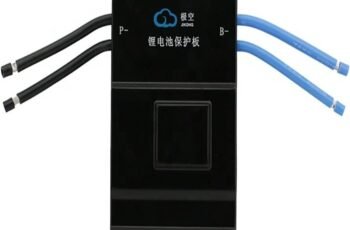
Have we ever wished we could actually see what our battery pack is doing in real time and keep every cell perfectly happy for years?
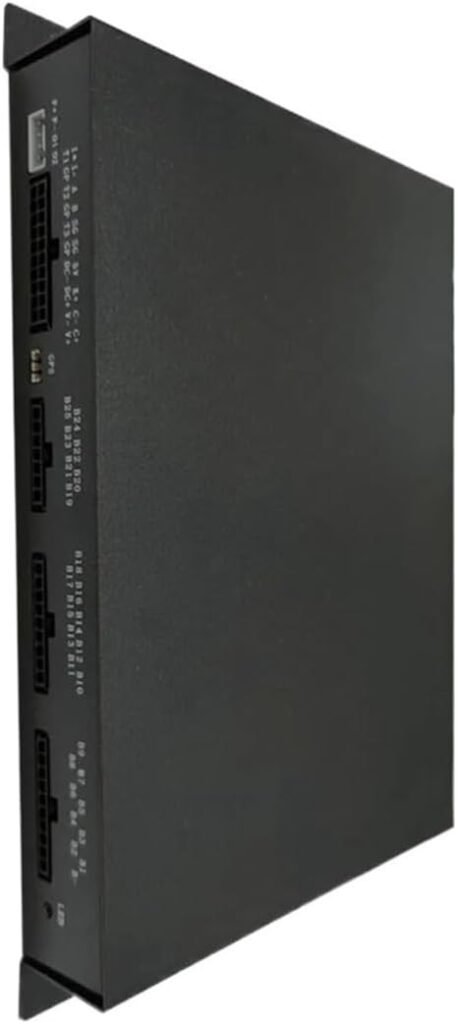

Understanding What the JK BMS Battery Equalizer Actually Is
When we first look at the name “JK BMS Battery Equalizer Jk Bms Active Balance Bms 8S 12S 13S 14S 16S 17S 20S 24S Smart Bms 60A 80A 100A 150A 200A 600A Lifepo4 Li-Ion Lto Battery Battery Protection Module (Color : B5A25S60P, Size”, it feels a bit overwhelming. But once we unpack it, we are basically talking about a smart, high‑current Battery Management System with active balancing and Bluetooth app control, suitable for many different pack configurations.
This unit is designed for serious DIY battery builds and custom systems: off‑grid solar, RV power, small backup systems, and other high‑capacity setups where we want more control than a basic BMS can offer. Its most important feature is the active balancing that helps keep every cell at nearly the same voltage, which in turn increases the usable capacity and lifespan of the whole pack.
Key Features of the JK BMS Battery Equalizer
We always appreciate seeing how a product’s main features connect to real‑world use. With this JK BMS, the highlighted points revolve around smart monitoring, safety, and long‑term efficiency.
JK’s Own Mobile App and Bluetooth Connectivity
We often struggle with BMS units that either require a laptop and special cable or only show cryptic LED codes. JK’s solution is to give us a dedicated mobile app, designed specifically for its BMS line, paired with Bluetooth communication.
Through this app, we can view real‑time data such as individual cell voltages, pack voltage, current, temperatures, and state of charge. We can also adjust many settings directly from our phone, which makes fine‑tuning the system dramatically easier than doing everything through DIP switches or PC software.
Active Balancing for Up to 99% Usage Efficiency
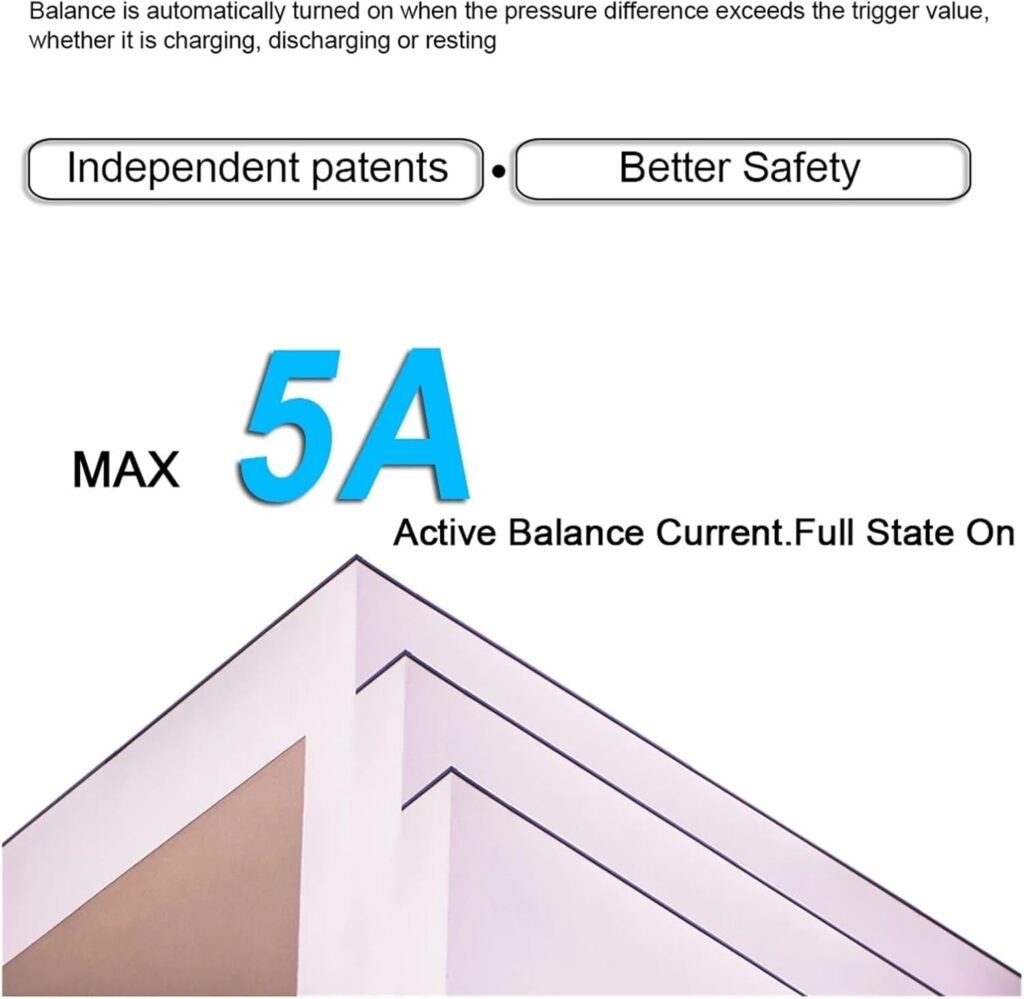
Instead of relying on passive balancing that burns off excess energy as heat, JK uses active balancing. This means the BMS can efficiently move charge from higher‑voltage cells to lower‑voltage cells, helping every cell stay at nearly the same level.
Active balancing is especially important in large packs where cell drift over time can drastically reduce usable capacity. By keeping cells more equal, JK claims efficiency up to 99% of the pack’s potential, which is impressive and aligns with how active equalization typically improves performance and cycle life.
Comprehensive Protection Functions
A BMS exists to protect both the battery and us as the users. This JK model offers all the core protections we expect, and ties them into a smart control logic:
- Over‑charge protection
- Over‑discharge protection
- Over‑current protection
- Short‑circuit protection
- Low‑temperature charging cut‑off
These safety features matter even more in large packs with higher currents. By cutting charge at low temperatures, for example, the unit helps prevent permanent damage to LiFePO₄ and other chemistries that do not tolerate cold charging well.
Wide Compatibility and Use Cases
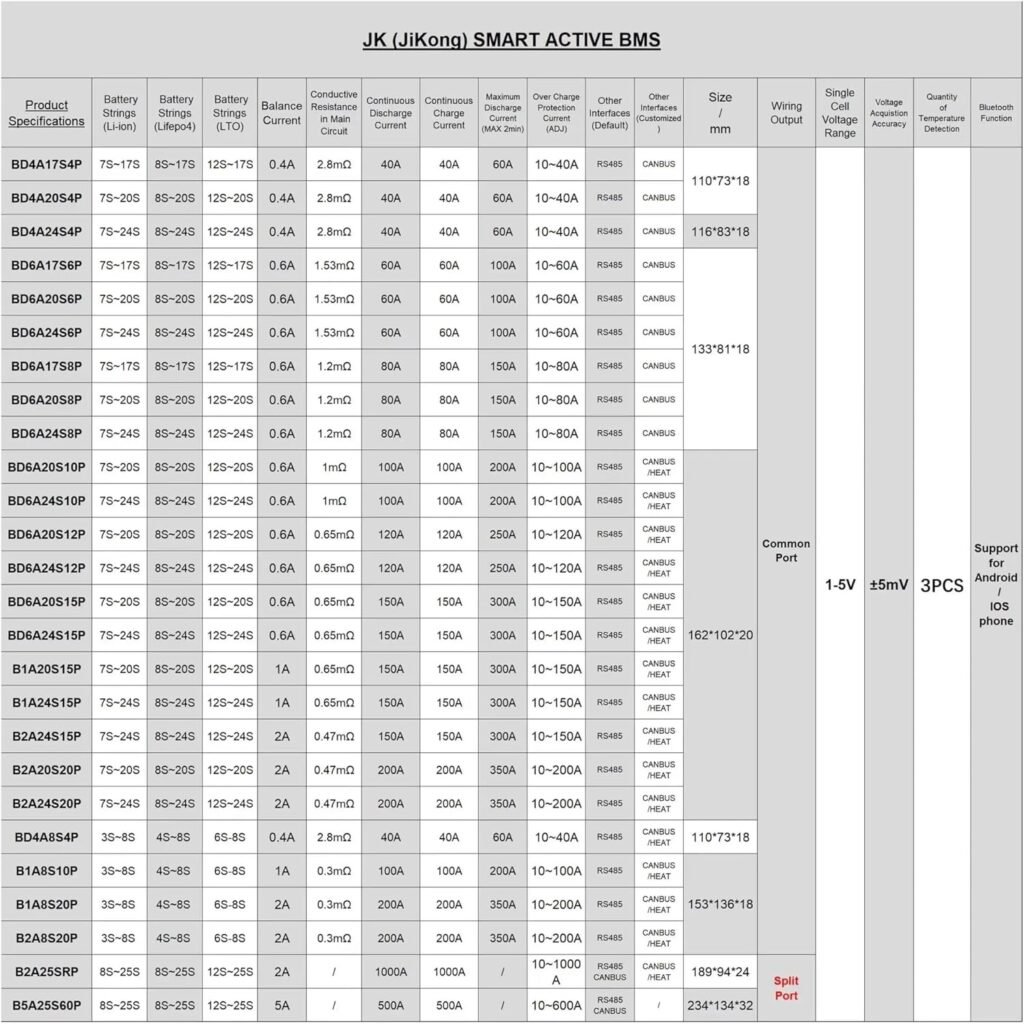
One of the standout aspects is how versatile this BMS is in terms of cell counts and system voltages. It supports packs from low to relatively high voltage, and the current ratings cover moderate to very high power systems.
According to the product details, it supports configurations like:
- 12V (4S)
- 24V (8S)
- 48V (16S)
- 72V (24S)
And beyond that, the name hints at compatibility with 8S, 12S, 13S, 14S, 16S, 17S, 20S, and 24S packs, depending on the exact variant we choose. That flexibility makes it appealing for many different projects without needing a separate BMS for each build.
Safety‑Focused Design Choices
We notice an emphasis on “unique design” and choosing the correct protection board for the right system. This matters because a mismatched BMS can actually shorten battery life instead of preserving it.
JK’s approach is to provide high current ratings, active balancing, and configurable protections so that, when chosen correctly, the BMS is not the weak link in a custom battery system. If we respect the specifications and wire everything properly, we can expect a safer and more reliable setup over time.

Specs and Capabilities at a Glance
It helps to summarize the JK BMS Battery Equalizer in a compact view. While exact details may vary by specific model variant, the general capabilities look like this:
| Feature | What It Offers |
|---|---|
| Cell Count Options | 8S, 12S, 13S, 14S, 16S, 17S, 20S, 24S (model‑dependent) |
| Typical System Voltages | 12V (4S), 24V (8S), 48V (16S), 72V (24S) |
| Supported Chemistries | LiFePO₄, Li‑ion, LTO (check variant for exact support) |
| Current Ratings (Variants) | Approx. 60A / 80A / 100A / 150A / 200A / up to ~600A |
| Balancing Type | Active balancing |
| Balancing Current | ~0.6 to 2A (active balance current) |
| App Support | JK dedicated app for configuration and monitoring |
| Connectivity | Bluetooth (BT) for real‑time monitoring |
| Safety Functions | Over‑charge, over‑discharge, over‑current, short‑circuit, low‑temp charge cutoff |
| Intended Use | DIY battery systems, solar, RV, home backup, and similar builds |
This table helps us quickly see how this BMS fits into high‑capacity DIY power projects. We can pick the exact combination of cell count and current rating that matches our planned system.
Real‑World Use: Who Is This JK BMS For?
We always like to picture how and where we might actually use a product. For the JK BMS Battery Equalizer, the target group is clearly DIY enthusiasts, off‑grid tinkerers, and system builders who want more control and better balancing than a typical budget BMS offers.
Ideal Scenarios and Projects
We might consider this JK BMS if we are:
- Building an off‑grid solar battery bank using LiFePO₄ cells in series
- Upgrading an RV or campervan power system with a custom lithium pack
- Assembling a home backup power system with inverter and large battery
- Maintaining a modular battery rack for workshops or remote cabins
- Experimenting with LTO or Li‑ion packs that need reliable balancing
The combination of high currents and advanced equalization makes this BMS suitable for systems where we intend to pull substantial power (inverter loads, heavy DC appliances) and want to squeeze as much life as possible out of the cells.
Who Might Not Need This Level of BMS?
If our project is something small and simple, like a single 12V drop‑in LiFePO₄ battery replacement for light camping use, this JK BMS might be more than we actually need. Simpler packs sometimes come with integrated BMS modules that are tuned for modest usage and do not require app‑based monitoring.
However, once we go beyond a basic plug‑and‑play battery into custom packs, the features of this JK model become far more useful and even necessary for safe operation.
Installation Experience and Learning Curve
We need to be honest with ourselves: installing and configuring a BMS like this is not the same as plugging in a power strip. It requires patience, careful wiring, and an understanding of battery fundamentals.
Wiring Considerations
We will be connecting:
- The main positive and negative leads for the pack
- Individual cell sense wires for each series connection
- Optional temperature sensors (depending on model)
- Possibly separate lines for charging and discharging, if the design uses different paths
The biggest part of the job is usually attaching the balance leads to each cell group in the correct order. With up to 24 cells in series, we must be meticulous. Mixing up even one or two wires can cause serious issues, including damaging the BMS.
Configuration via the JK App
Once the wiring is complete, we turn to the JK app for configuration. Through the app we can:
- Set cell over‑voltage and under‑voltage thresholds
- Configure charge and discharge current limits
- Adjust temperature limits for charging and discharging
- Monitor each cell’s voltage, pack current, SOC, and more
This configuration step is essential. If we simply accept all default values, they may not match the exact chemistry or manufacturer recommendations for our cells. We should be ready to read our cell spec sheets and enter suitable parameters.
The upside is that once everything is dialed in, we can monitor and tweak the system without opening up the battery box every time.
Active Balancing: Why It Matters to Our Pack
Active balancing is often the main reason we would choose this JK BMS over cheaper alternatives. Many of us have seen how passive balancing can struggle to keep large packs in line, especially as cells age or if we occasionally stress the system.
The Difference Between Active and Passive Balancing
With passive balancing, the BMS bleeds off extra energy from higher cells through resistors, converting that surplus into heat. It works, but it is slow and inherently wasteful.
With active balancing, the BMS shifts charge from higher cells to lower ones, moving energy within the pack instead of throwing it away. This is more efficient, especially with a balancing current in the 0.6–2A range, as described for this JK unit.
The practical benefits for us include:
- Faster correction of significant cell imbalances
- Better utilization of total pack capacity
- Potentially longer cell life, because cells do not spend as much time at extreme voltages
When Active Balancing Really Shines
Active balancing makes the biggest difference in systems where:
- We have many cells in series (16S, 20S, 24S)
- The pack is cycled deeply and regularly
- We have used cells from different batches or slightly mismatched capacities
- The system is older, and cells begin drifting apart more noticeably
In those situations, the JK BMS can reduce the need for frequent manual balancing or capacity testing, making long‑term maintenance easier and the pack more predictable in day‑to‑day use.
Safety and Protection: How the JK BMS Guards Our System
We all want peace of mind, especially when dealing with high current and large amounts of stored energy. The JK BMS Battery Equalizer builds a safety net around the battery by monitoring multiple parameters simultaneously.
Voltage Protection for Each Cell
Over‑charge and over‑discharge protections are among the most critical features. The BMS tracks each cell’s voltage and will cut off charging if any cell exceeds the configured max voltage, and cut off discharge if any cell drops too low.
This helps prevent cell swelling, rapid degradation, and the catastrophic failure that can follow severe over‑charge or under‑voltage conditions.
Current and Short‑Circuit Protection
The JK BMS also monitors current going in and out of the pack. If we exceed the set current limit, it can interrupt the circuit to protect both the cells and the wiring.
In the event of a short circuit, the BMS acts as an additional barrier. While we should still size fuses and circuit breakers properly, the BMS adds another layer of safety, which is invaluable in complex DIY systems.
Temperature‑Based Charging Control
Low‑temperature charging cutoff is another major advantage, particularly for LiFePO₄ cells that should not be charged below a certain temperature to avoid plating and permanent damage.
If the BMS senses that temperatures are too low for safe charging, it will stop charging operations until conditions improve. This is especially helpful in seasonal or outdoor setups where the battery may experience wide temperature swings.
Long‑Term Reliability and Battery Longevity
We are often building these systems for years of use, not weeks. The JK BMS’s design choices aim to support that kind of longevity through careful management and optimization of the pack.
Reducing Stress on Individual Cells
By keeping all cells in a narrower voltage window, active balancing helps avoid scenarios where a few weak cells are always overcharged or deeply discharged sooner than the others. Over the long haul, this more uniform treatment can mean:
- Lower capacity loss per cycle
- More consistent performance from year to year
- Fewer surprises when we need peak power from the pack
Making Data‑Driven Decisions with the App
The app is not just for setup; it gives us the data we need to make better decisions about how we use and maintain our battery. We can:
- Watch how individual cells behave under heavy loads
- Track changes in cell balance over time
- Adjust usage patterns if we see worrying trends
This level of visibility lets us intervene early—maybe we choose to recondition a pack, replace a particular cell group, or reduce maximum current draw—before real damage occurs.
Pros and Cons of the JK BMS Battery Equalizer
No product is perfect, and it is useful for us to weigh the strong sides and the potential drawbacks in one place.
What We Are Likely to Appreciate
We see several compelling strengths in this BMS:
- Active balancing with decent current (0.6–2A) for more effective equalization
- Robust current handling options from 60A up to around 600A (model‑dependent)
- Dedicated mobile app for both monitoring and configuration
- Support for multiple chemistries like LiFePO₄, Li‑ion, and LTO
- Wide range of cell counts and system voltages, making it flexible
- Comprehensive safety protections, including low‑temp charge cut‑off
- Designed with serious DIY projects and high‑capacity systems in mind
These strengths make it particularly attractive for off‑grid and high‑performance builds where reliable balancing and detailed control matter a lot.
What Might Be Challenging or Limiting
There are also a few factors we should keep in mind:
- Installation complexity: Multicell wiring with many balance leads is not trivial.
- Configuration requirements: We must understand our cells and set the right thresholds.
- Potential overkill for small systems: Simple, small‑capacity packs might not need this level of functionality.
- Model variations: We need to be careful to choose the specific JK BMS version that matches our desired series count and current.
If we are starting completely from scratch with no prior battery experience, this BMS might feel like a big step up in complexity. Learning gradually and double‑checking every connection is crucial.
Choosing the Right Variant for Our Project
Because the product line covers such a wide range—different series counts and currents—we have to match the BMS variant carefully to our system design.
Matching Cell Count and System Voltage
Our first decision is the number of series cells (S) in our pack. That will determine which JK BMS configuration we need. For instance:
- A 12V LiFePO₄ pack typically uses 4S, but this particular BMS line is often listed more for 8S and above.
- A 24V system uses 8S LiFePO₄ cells.
- A 48V system uses 16S.
- A 72V system uses 24S.
We want the BMS to support at least the number of series cells we plan to use, and we should choose exactly the right S‑count model if one is specified.
Matching Current Rating to Our Loads
Next, we evaluate how much current our inverter or DC loads will draw. If our inverter can draw up to 150A continuous from the battery, we should choose a BMS rated for at least that much continuous discharge current, and with some margin for safety.
Available variants around 60A, 80A, 100A, 150A, 200A, up to around 600A give us plenty of options. Undersizing the BMS is a common mistake, so we should be honest about our maximum loads, especially surge currents.
Confirming Chemistry Compatibility
The product mentions LiFePO₄, Li‑ion, and LTO support. Different chemistries have different recommended voltages and temperature ranges. We should make sure:
- Our chosen variant explicitly supports our chemistry.
- We configure all voltage and temperature limits to match the cell manufacturer’s datasheet.
This ensures the BMS protects the cells according to their actual requirements, not just generic lithium settings.
Using the JK BMS in a DIY System
To get a sense of how this works in practice, we can imagine a common scenario: building a 48V LiFePO₄ solar battery bank with a 5kW inverter.
Example: 16S LiFePO₄ Pack at 48V
In this scenario, we might choose a 16S JK BMS rated for 150A or 200A to support our 5kW inverter (which would pull around 100–120A at 48V under full load, plus some margin for surge). We would:
- Assemble 16 LiFePO₄ cells in series.
- Install the JK BMS, wiring the main battery leads and each balance wire to the corresponding cell connection.
- Connect temperature sensors near critical cell locations.
- Configure cell voltage limits, pack current limits, and temperature thresholds using the JK app.
- Hook the output to the inverter and solar charge controller, following proper fusing and cable sizing practices.
With this setup, the active balancing helps keep all 16 cells aligned, while the app gives us per‑cell data and lets us monitor the system from our phone.
Everyday Operation
On a daily basis, we would:
- Check the app occasionally to see pack SOC and any alerts.
- Notice if any cell consistently runs higher or lower than the rest.
- Adjust charging or load behavior if we see any problematic trends.
The BMS operates mostly in the background, automatically enforcing protections and balancing as needed, so we can spend more time using the system and less time worrying about it.
Practical Tips for Getting the Most from This BMS
We can significantly improve our experience by following a few practical guidelines and best practices.
Double‑Check Wiring Before Power‑Up
Before we ever connect the main pack leads:
- Verify every balance lead is on the correct cell tap.
- Confirm polarity and series order carefully.
- Use a multimeter to check cell group voltages.
Catching mistakes before powering up can prevent damaged components and frustrating troubleshooting sessions.
Start With Conservative Settings
When we first configure the BMS via the app, it is wise to start with slightly conservative voltage and current limits. For example:
- Set charge current below the absolute max recommended by the cell datasheet.
- Keep cell over‑voltage just under the maximum recommended charge voltage.
- Set discharge cut‑off slightly above the minimum safe cell voltage.
Once we are sure everything is working as expected, we can decide whether to optimize for a little more capacity if the chemistry and cells allow.
Keep Firmware and App Updated
If JK issues firmware or app updates, they may fix bugs or add useful features. Periodically checking for updates helps keep our BMS at its best and reduces sporadic issues with connectivity or display.
Maintain Good Thermal Conditions
Even a good BMS cannot compensate for extreme ambient temperatures. If possible:
- Keep the battery pack in a space with moderate, stable temperatures.
- Allow airflow around the BMS and main cables.
- Avoid direct sunlight on the pack enclosure in hot climates.
This supports both the cells and the BMS electronics in performing reliably over the long term.
How This JK BMS Compares to Simpler Units
We often face a decision between a cheaper, basic BMS and a more advanced unit like this JK model. Understanding the practical differences helps justify the investment.
What We Gain by Choosing JK’s Active Smart BMS
Compared to budget BMS boards that only offer basic over‑voltage and under‑voltage protection, we gain:
- Active balancing instead of slow, wasteful passive bleed balancing
- Higher current capacity for powerful systems
- Granular app‑based configuration instead of fixed or crude settings
- Detailed monitoring of each cell rather than just pack‑level indicators
These benefits make a real difference once our pack reaches a certain size or complexity, especially when we care about performance and lifespan.
When a Simple BMS Might Be Enough
If we are wiring a small 4S pack for light intermittent loads, where we rarely approach maximum capacity, a basic BMS can be adequate. It might not keep everything perfectly balanced, but for a casual application we might never notice.
However, for any system where:
- Replacement cells would be expensive or time‑consuming to source
- We rely on the battery for daily power needs
- We regularly cycle deeply or pull high currents
this JK BMS looks like a more responsible choice.
Overall Value and Final Thoughts
When we step back and look at the overall package, the JK BMS Battery Equalizer Jk Bms Active Balance Bms 8S 12S 13S 14S 16S 17S 20S 24S Smart Bms 60A 80A 100A 150A 200A 600A Lifepo4 Li‑Ion LTO Battery Battery Protection Module (Color : B5A25S60P, Size) presents itself as a feature‑rich, advanced BMS platform for ambitious DIY and semi‑professional battery projects.
We gain:
- Strong safety protection
- Sophisticated active balancing with decent current
- Flexible support for multiple chemistries and system sizes
- A mobile app that turns the invisible workings of our pack into visible, adjustable data
We do need to be ready for the complexity that comes with this level of control. Proper installation, correct configuration, and good wiring practices are essential. But if we are committed to getting the most out of our cells and we enjoy understanding our system rather than treating it as a black box, this JK BMS aligns well with that mindset.
In the long run, protecting a large, expensive battery bank with a well‑designed, actively balancing smart BMS can save us money, time, and frustration. For those of us building serious LiFePO₄, Li‑ion, or LTO systems, this JK unit is a compelling option we can confidently consider as the central brain and guardian of our battery pack.
Disclosure: As an Amazon Associate, I earn from qualifying purchases.