Have you been looking for a battery-to-battery charger that just works reliably, safely, and efficiently in your van, RV, boat, or off‑grid setup?

What the Sterling Power Battery to Battery Charger Actually Does for You
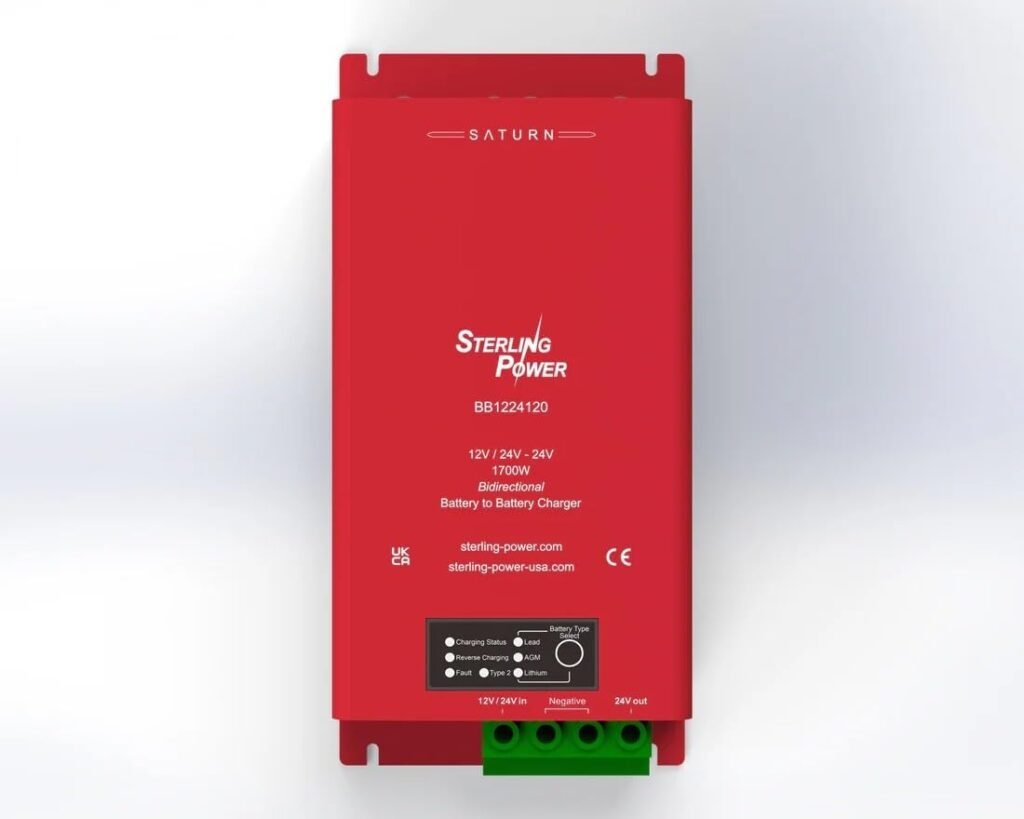
When you read “Sterling Power Battery to Battery Charger 12V OR 24V Input to 24V Output 120amp DC Powered Charger,” it can sound a bit technical. In simple terms, you are getting a powerful, smart DC‑to‑DC charger that takes energy from one battery (or alternator) and charges your 24V battery bank correctly and safely.
You can feed it from either a 12V or 24V source, and it always outputs 24V. That makes it ideal if you are running a 24V house battery system but your vehicle or boat still uses a 12V or mixed system. It helps you keep everything topped up while looking after your batteries and alternator.
Key Features You Actually Care About
You do not just want a list of specs; you want to know how each feature helps you in real life. Here is what stands out:
Buck‑Boost Design and High Efficiency
This charger uses a buck‑boost design, which means it can raise or lower the input voltage to give a stable 24V output. That makes it extremely flexible if your input source fluctuates, like a vehicle alternator or long cable runs.
Because it is 95–98% efficient, very little energy is wasted as heat. That helps you in two ways: you lose less power as heat, and the unit stays cooler even when you run it hard for long periods.
120A Output for Fast, Serious Charging
At up to 120 amps of DC output, you are dealing with a genuinely high‑capacity charger. If you are running a decent‑sized 24V house bank, you can recover capacity quickly while you drive or run your engine.
Instead of needing a long engine run or generator time, you replenish your 24V battery bank much faster. That can make a big difference on trips where you are moving most days and want to arrive with your batteries nearly full.
Input and Output: How It Fits Into Your System
Understanding how this charger works with your specific setup is essential. You might have a standard alternator, lithium batteries, solar, or all of the above.
12V or 24V Input to 24V Output
You can feed this charger with:
- A 12V starter battery system
- A 24V starter battery system
Either way, the output is 24V. That is perfect if:
- Your van or truck is 12V, but you want a 24V house bank.
- Your boat is 24V, and you want a controlled, smart charge to a 24V house bank.
This flexibility lets you upgrade to a high‑performance 24V system without having to re‑engineer your whole vehicle’s electrical system.
Bi‑Directional Charging and “Jump Start” Support
One of the standout features is bi‑directional charging. The charger does not only look after your house battery; it can help your starter battery too.
If your 24V house battery has plenty of charge—say after solar or a long drive—the charger can keep your start battery topped up. This is a big deal when you are off‑grid for days and want to be sure the engine will start when needed.
You can also use a “jump start” mode to help if your start battery gets depleted. That backup option gives you peace of mind and reduces the risk of getting stranded.
Installation and Setup: What You Can Expect
You may not want a product that forces you into hours of complex configuration. This charger aims to be more user‑friendly while still offering advanced options when you need them.
Simple Installation for a Complex Device
You get a straightforward setup process:
- Mount the unit in a suitable, ventilated location.
- Connect input cables to your starter battery/alternator side.
- Connect output cables to your 24V house battery bank.
- Select your battery type using presets.
Once you choose the correct preset and trigger method, the charger handles the rest. You are not required to manually program complicated charge profiles unless you really want to fine‑tune things.
Flexible Trigger Options: Voltage, Ignition, or Vibration
You have several ways to tell the charger when to turn on and off:
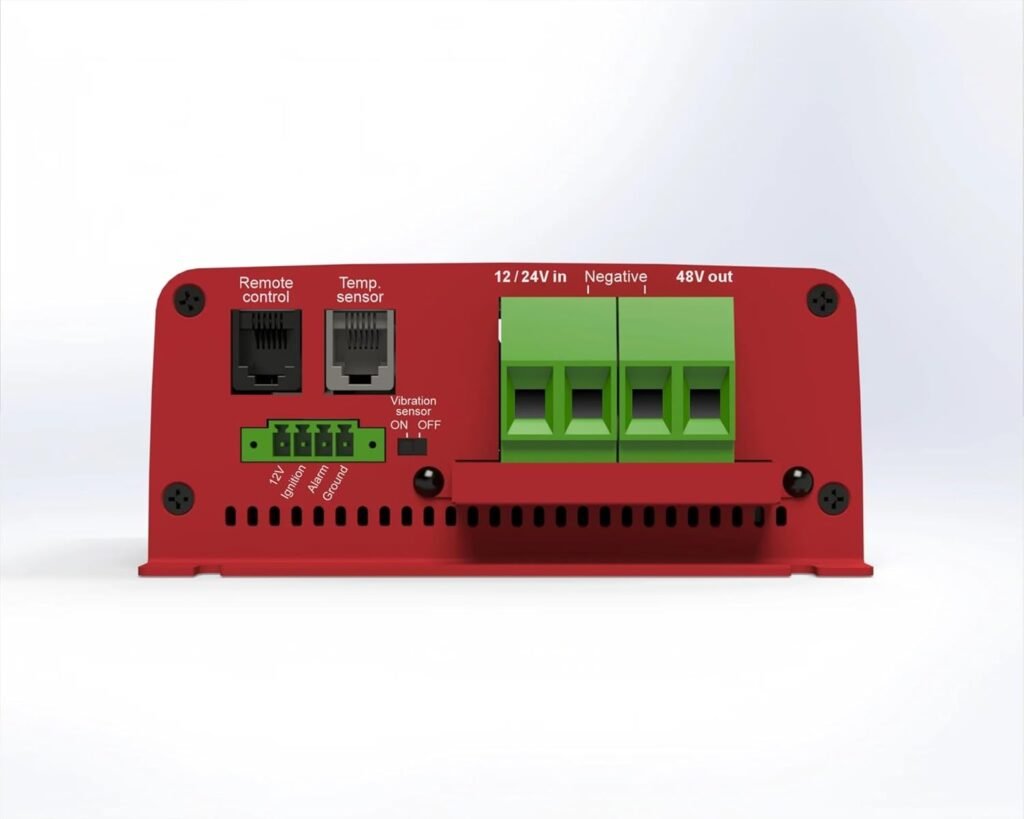
- Alternator voltage sense (default) – The unit monitors voltage and turns itself on when it detects the alternator running.
- Ignition trigger – You can wire it to an ignition circuit, so it only charges when you turn the key or press the start button.
- Vibration sense – It can detect engine vibration and use that to start or stop charging.
These options help you avoid draining your starter battery by preventing the charger from running when the engine is not actually producing power.
Smart Alternator and Euro 6+ Compatibility
Modern vehicles, especially Euro 6+ engines and smart alternator systems, are not friendly to basic split‑charge relays. Voltage can fluctuate in ways that confuse traditional chargers.
Why Smart Alternator Support Matters for You
If you have a more modern van or truck (like a Sprinter or similar Euro 6+ vehicle), the alternator may:
- Drop voltage aggressively for fuel efficiency.
- Cycle on and off under ECU control.
This charger is built to handle that environment. It works with smart alternators by using voltage sensing, ignition feed, or vibration sense, so it can still charge reliably even when your vehicle’s on‑board systems are trying to save fuel.
Better Than a Simple Split‑Charge Relay
A simple relay just connects batteries together when voltage rises. That worked with older alternators but is less reliable with modern, variable‑voltage systems.
With this DC‑DC charger, you get:
- Consistent charging even with variable alternator voltage.
- Proper multi‑stage charging profiles instead of just “on/off.”
- Protection for both batteries from over‑discharge or over‑charge.
You end up with a system that is more robust and much kinder to your battery investments.
Battery Chemistry Support: Lead Acid, AGM, and Lithium
If you are running lithium (LiFePO4) or plan to upgrade, you do not want a charger that locks you into old‑school profiles. This is where the Sterling unit is particularly strong.
Six Presets for Popular Battery Types
You get six built‑in charging presets to match different battery chemistries. These cover:
- Standard flooded lead acid
- AGM variants
- Gel
- Lithium (with at least two separate lithium options)
By selecting the correct preset, you allow the charger to apply correct absorption voltages, float stages, and charging algorithms tailored to your battery type.
Lithium Profiles and Low Temperature Protection
Lithium batteries have unique needs:
- They should not be charged below freezing.
- They prefer tightly controlled voltage limits.
- Overcharging can be more dangerous.
The charger includes two different lithium profiles along with a low temperature trip designed specifically for lithium. That means if the temperature reads too low, the charger will stop charging rather than risk damaging your lithium bank.
If you are using LiFePO4 in colder climates, this protection is especially important for long‑term battery health and safety.
Protecting Your Alternator and Electrical System
Running a large DC‑to‑DC charger can stress your alternator if the device just pulls everything it can. The Sterling unit deals with this more intelligently.
Current Limiting for Alternator Safety
With current limiting, the charger can cap how much power it draws. That helps you:
- Avoid overheating your alternator.
- Prevent early alternator failure from constant high load.
Instead of trying to pull the absolute maximum current at all times, the charger respects safe limits. You can push your charging system hard but not recklessly.
Self‑Recovering Protections
The charger includes six self‑recovering protections. While the product details do not list them individually, such protections typically include:
- Over‑temperature protection
- Over‑voltage protection
- Under‑voltage protection
- Reverse polarity protection
- Over‑current protection
- Short‑circuit or fault protection
“Self‑recovering” means that after a fault condition clears (for example, temperature drops back to normal), the charger will resume operation automatically without you having to reset it manually.
Real‑World Use Cases: How You Might Actually Use It
To help you picture how this charger can fit into your life, consider a few typical setups where it shines.
Van Life and Camper Conversions
If you have a camper van or self‑converted rig:
- Your van likely has a 12V starter system.
- You may want a 24V lithium house battery bank for higher efficiency and performance.
This charger lets you feed that 24V house bank directly from your alternator while protecting both the alternator and your expensive lithium batteries. Because it supports smart alternators and ignition/vibration triggers, you do not have to worry as much about draining your starter battery while parked.
Boats and Marine Setups
On a boat, you might have:
- A 24V starter or thruster system.
- A separate 24V house bank with large capacity.
The Sterling charger can keep the house bank topped up from engine running time. And with bi‑directional charging, you can share power in a controlled way to support your start battery when necessary, particularly if your house bank is getting help from solar.
Off‑Grid and Overlanding Systems
For overlanding rigs or off‑grid work trucks:
- You often mix alternator charging, solar, possibly wind or generator.
- Reliability and redundancy matter more than anything.
This charger fits alongside a solar charge controller to create a hybrid charging setup. If solar is active and topping your house bank, the bi‑directional feature can still care for the starter battery, which reduces the risk of coming back to a dead engine battery after a few days at camp.
Ease of Use: Day‑to‑Day Experience
Beyond specs, you want to know what it feels like to live with this device and whether it adds hassle or reduces it.
“Set and Forget” Once You Choose Your Profile
For most users, once you:
- Install the unit properly
- Select the correct battery type preset
- Choose your preferred trigger method
…you can mostly forget about it. The charger automatically responds to engine operation, battery voltages, and its internal logic.
You do not need to constantly adjust anything. The logic is designed to look after your system in the background.
Quiet and Cool Operation
Because the efficiency is rated at 95–98%, the unit does not generate as much heat as many alternatives. Less waste heat means:
- Fans (if present) do not have to work as hard or as often.
- You can mount it in tighter spaces (still respecting ventilation requirements).
- Components are under less thermal stress over the long term.
You get consistent performance even during extended drives or long engine runs needed for deep charging.
Strengths and Weaknesses at a Glance
To help you quickly see how this charger measures up, here is a clear breakdown.
Main Advantages
You benefit from a combination of advanced design, safety, and flexibility:
- Very high efficiency (95–98%) keeps heat and energy loss low.
- Buck‑boost design handles variable input (12V or 24V) and still gives solid 24V output.
- 120A output is strong enough for bigger house banks and faster charging.
- Bi‑directional charging supports both start and house batteries.
- Lithium support with multiple profiles and low temperature protection.
- Smart alternator/Euro 6+ compatible for modern vehicles.
- Multiple trigger modes: voltage sense, ignition feed, vibration sense.
- Current limiting protects your alternator from overload.
- Six charging presets and six self‑recovering protections.
Possible Drawbacks to Consider
No product is perfect for every user. You may want to keep in mind:
- 120A output may be more than you need for smaller systems.
- High current capacity usually means thicker cables and careful installation, which may raise install cost.
- If you only ever run basic lead‑acid and a simple alternator, some features might be more advanced than you strictly need.
Even so, if you expect your system to grow or you plan a lithium upgrade, this charger positions you well for the future.
Key Specifications and Features in a Simple Table
To make things easier to scan, here is a summary of the most important information.
| Feature / Spec | What It Means for You |
|---|---|
| Product Name | Sterling Power Battery to Battery Charger 12V OR 24V Input to 24V Output 120amp DC Powered Charger |
| Input Voltage | Works with 12V or 24V starter/alternator systems |
| Output Voltage | 24V fixed, suitable for 24V house battery banks |
| Maximum Output Current | Up to 120A for fast charging |
| Charger Design | Buck‑boost, high‑efficiency DC‑DC conversion |
| Efficiency | About 95–98%, meaning very little power lost as heat |
| Charging Direction | Bi‑directional; can support both house and starter batteries |
| Smart Alternator Compatible | Yes, including Euro 6+ vehicles such as Sprinter vans |
| Trigger Modes | Alternator voltage sense, ignition feed, or vibration sense |
| Battery Type Support | Presets for multiple chemistries including lead acid, AGM, gel, and lithium |
| Lithium Support | Two lithium profiles plus low temperature charge trip |
| Protection Features | Six self‑recovering protections (over‑temp, over‑voltage, under‑voltage, etc.) |
| Alternator Protection | Current limiting to avoid alternator overload and overheating |
| Use Cases | Vans, RVs, overland rigs, boats, off‑grid systems needing 24V house banks |
| Setup Complexity | Simple preset selection and wiring; advanced options available if you want more control |
| Additional Benefit | “Jump start” style support for depleted start batteries when house bank is healthy |
This should help you quickly decide whether the feature set aligns with what you need now and what you might want later.
Safety and Reliability in Long‑Term Use
You are likely putting this into a system that must work reliably, possibly in remote places. That makes safety and resilience more than just buzzwords.
Thermal Management and Long‑Run Operation
Running at 95–98% efficiency means:
- Less heat inside the unit.
- Less thermal stress on internal components.
- Better performance during prolonged, heavy charging sessions.
If you ever run long drives to replenish a large bank, your charger will not easily overheat or throttle back unnecessarily. You can rely on more consistent output.
Protections That Self‑Recover
When something goes wrong—over‑temperature, for example—you want the system to protect itself without dying permanently. Self‑recovering protections mean that:
- The charger temporarily shuts down or reduces output to protect itself.
- Once conditions return to normal, it restarts automatically.
You can be less concerned about rare fault conditions leaving you with a completely non‑functional system in the middle of a trip.
Integrating With Solar and Other Charging Sources
Most modern setups do not rely on just one source. You may have alternator charging, solar, and possibly shore power or generator charging.
Working Alongside Solar
If you have solar panels connected to your house bank:
- The Sterling charger can still accept input from your alternator and add its own charge on top of solar.
- If solar charges the house bank well, surplus energy can help keep your start battery topped via the bi‑directional logic.
This synergy means that driving time and sunlight both contribute efficiently without you manually switching anything.
Avoiding Conflicts Between Chargers
When you already have a solar charge controller or a shore power charger, you might worry about devices “fighting” each other. In practice:
- Each charger manages its own output based on battery voltage and internal logic.
- As the battery nears full, all chargers taper down.
Because the Sterling unit is designed for multi‑stage charging and proper voltage regulation, it plays well with other smart chargers targeting the same bank.
Who This Charger Is Best Suited For
You might be wondering where you fit on the spectrum of users for this product.
Ideal for Power‑Hungry and Advanced Systems
You will benefit the most from this charger if:
- You run or plan to run a 24V house battery bank.
- You have or intend to switch to lithium (LiFePO4) batteries.
- You have a modern vehicle with a smart alternator.
- You need fast charging (up to 120A) for a large capacity bank.
In that situation, the Sterling unit becomes the central, heavy‑duty backbone of your alternator‑to‑battery system.
Still Useful for Simpler Lead‑Acid Banks
Even if you stick to traditional lead‑acid or AGM:
- The charger will still provide proper multi‑stage profiles.
- It will still protect your alternator with current limiting.
- It will still offer bi‑directional charging to care for both banks.
If you think your system might grow or change later, starting with a device this capable saves you from replacing your charger when you upgrade to lithium or expand capacity.
Practical Tips for Getting the Most From It
To make this unit work at its best in your setup, a few practical points can help.
Pay Attention to Cable Sizing and Fusing
At up to 120A DC:
- You need appropriately thick cables to reduce voltage drop and heat.
- You should install fuses or breakers rated for the expected current, on both input and output sides, as near to the batteries as practical.
If you are unsure, it is worth consulting cable sizing charts or working with a professional installer. Getting cable size and protection right is critical for both performance and safety.
Choose the Right Battery Preset
Make sure you:
- Check your battery manufacturer’s recommended charge voltages.
- Match those recommendations as closely as possible with one of the six presets.
- If necessary, fine‑tune settings (if allowed) for more precision.
This ensures you charge your batteries optimally rather than just “well enough.”
Use the Best Trigger Mode for Your Vehicle
If your vehicle has a modern smart alternator, you may get the best behavior using:
- Ignition trigger, or
- Vibration sense
This reduces the chance of the charger turning on when the engine is off, or failing to turn on if the alternator voltage is not behaving like an older fixed‑voltage unit.
How This Charger Compares to Simpler Alternatives
To decide if this is worth it for you, it helps to compare it with the most common alternative setups.
Compared to a Simple Voltage‑Sensing Relay (VSR)
A basic relay:
- Just connects batteries together when voltage rises above a threshold.
- Does not regulate charging voltage or current.
- Can be unreliable with smart alternators.
By contrast, this Sterling charger:
- Actively regulates voltage and current to match battery needs.
- Works well with smart alternators, not just old‑style ones.
- Provides multi‑stage charging and lithium‑safe operation.
If you care about longevity of your batteries and compatibility with modern vehicles, a VSR cannot match what this DC‑DC charger does.
Compared to Smaller, Low‑Amp DC‑DC Chargers
Smaller DC‑DC chargers in the 20–40A range can be fine for modest setups, but:
- They take much longer to recharge large house banks.
- They may struggle if your daily usage is high.
With 120A available, you:
- Recharge much faster between camps.
- Reduce the need to idle your engine for long periods.
- Make better use of shorter driving days.
The tradeoff is that you need to pay attention to cable sizing and alternator capability, which the Sterling helps with via current limiting.
Long‑Term Value for Your System
You might be looking at the price tag and wondering if the investment is justified over time.
Extending Battery Life
By using correct charging voltages, stages, and temperature protections:
- Lead‑acid batteries can avoid sulfation and under‑charging.
- Lithium batteries can avoid over‑charging or low‑temperature damage.
Longer battery life directly translates into cost savings, as your expensive house bank will not need replacement as frequently.
Protecting Your Alternator and Electronics
With current limiting and built‑in protections:
- Your alternator is less likely to burn out from over‑demand.
- Your wiring and batteries are less likely to be exposed to unsafe conditions.
Repairing an alternator or dealing with electrical damage can be far more expensive and inconvenient than investing in a charger that manages current intelligently.
Final Thoughts: Is This Charger Right for You?
If you are building or upgrading a 24V house system fed from a 12V or 24V starter battery, the Sterling Power Battery to Battery Charger 12V OR 24V Input to 24V Output 120amp DC Powered Charger gives you a powerful, efficient, and highly flexible core component.
You get:
- 120A of charging capacity with high efficiency and low heat.
- Buck‑boost operation to adapt 12V or 24V input into solid 24V output.
- Reliable compatibility with smart alternators and Euro 6+ vehicles.
- Thorough lithium support, including low temperature protection.
- Bi‑directional charging so both your house and start batteries stay healthy.
- Multiple trigger options and six built‑in presets, making setup straightforward.
If your system is small and you never plan to upgrade, you might be fine with a less capable charger. But if you care about speed, safety, battery health, and future‑proofing, this Sterling DC‑DC charger offers a strong, well‑rounded solution that supports both your daily use and long‑term reliability.
Disclosure: As an Amazon Associate, I earn from qualifying purchases.