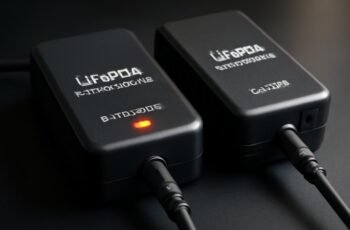
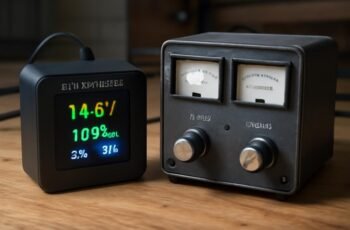
Some might assume that adding Bluetooth functionality complicates battery management, but it actually enhances control and data accuracy. When evaluating LiFePO4 chargers, understanding the trade-offs between Bluetooth-enabled units and traditional models is essential for peak system performance. The decision impacts not only monitoring capabilities but also reliability, security, and cost. To determine which approach best aligns with your operational needs, it’s essential to analyze these differences thoroughly.
Key Takeaways
- Bluetooth chargers offer real-time remote monitoring of voltage, current, and temperature, enhancing battery health management.
- Non-Bluetooth chargers are simpler, more reliable, and less prone to communication failures, ideal for basic applications.
- Bluetooth connectivity enables proactive adjustments but may face range interference and security vulnerabilities.
- Non-Bluetooth chargers are cost-effective, with lower upfront costs and minimal electronic components.
- Choose Bluetooth for advanced monitoring and control; opt for non-Bluetooth for durability, safety, and affordability.
How Bluetooth-Enabled Chargers Enhance Battery Monitoring and Control
Have you ever wondered how Bluetooth-enabled chargers improve battery management? These chargers leverage Bluetooth integration to enable real-time battery monitoring, providing detailed data on voltage, current, and temperature. This continuous flow of information allows us to analyze battery health dynamically, reducing risks of overcharging or overheating. By transmitting data wirelessly, users can access critical metrics remotely via smartphones or control panels, enabling proactive adjustments. This precise monitoring enhances overall battery longevity and performance. Additionally, Bluetooth integration facilitates automated control features, such as optimized charging cycles based on real-time conditions. Consequently, Bluetooth-enabled chargers offer a more sophisticated approach to battery management, ensuring safer, more efficient operation through advanced battery monitoring and remote control capabilities.
Key Differences Between Bluetooth and Non-Bluetooth LiFePO4 Chargers
Bluetooth-enabled chargers distinguish themselves from traditional non-Bluetooth models primarily through their ability to provide real-time data access and remote management features. This connectivity allows users to monitor charging status, voltage, and temperature remotely, enhancing operational oversight. However, Bluetooth limitations include reliance on wireless signals, which can be affected by interference or range issues, and potential security vulnerabilities. In contrast, non-wireless options, such as wired chargers, eliminate connectivity concerns but lack remote monitoring capabilities. These chargers are typically simpler, more reliable, and less susceptible to communication failures. The key difference lies in connectivity versus simplicity: Bluetooth chargers offer advanced control at the expense of potential limitations, while non-wireless options prioritize dependability over remote access.
Pros and Cons of Bluetooth Chargers for Different User Needs
What makes Bluetooth chargers suitable for certain users but less ideal for others depends largely on their specific needs and operational contexts. Bluetooth charging offers real-time lithium battery monitoring via smartphone app controls, enhancing battery safety by detecting issues early. This connectivity improves charging efficiency through precise parameter adjustments, reducing overcharging risks. However, reliance on Bluetooth introduces potential vulnerabilities like connectivity issues or software compatibility challenges, which can hinder consistent operation. Non Bluetooth charging systems, while lacking remote monitoring, tend to be simpler and more robust, especially in environments where connectivity is unreliable. For users prioritizing detailed monitoring and control, Bluetooth chargers excel, but those valuing straightforward, dependable operation may prefer traditional non Bluetooth options. The choice hinges on balancing advanced features against operational simplicity.
When to Choose a Non-Bluetooth Charger for Your Lithium Battery Setup
Choosing a non-Bluetooth charger becomes advantageous when the operational environment demands simplicity and reliability over advanced connectivity features. In safety-critical applications, minimizing potential points of failure—such as wireless communication modules—enhances battery safety. Non-Bluetooth chargers often have fewer electronic components, reducing the risk of malfunctions that could compromise the lithium battery setup. Additionally, cost considerations play a significant role; these chargers generally have lower upfront costs and reduced maintenance expenses due to their straightforward design. For installations where remote monitoring isn’t essential, opting for a non-Bluetooth charger ensures dependable operation without the complexity of wireless features. This approach prioritizes safety, durability, and affordability, making it ideal for static or industrial environments where simplicity and reliability are paramount.
Making the Right Choice: Which Charger Suits Your Lifestyle and Budget?
Determining the most suitable charger requires a careful assessment of your specific energy needs, lifestyle preferences, and budget constraints. If you prioritize real-time data and remote management, a Bluetooth monitoring-enabled charger offers advanced diagnostics and control, justifying a higher investment. Conversely, if simplicity and reliability are paramount, a non-Bluetooth charger provides straightforward operation with minimal maintenance. Budget considerations also influence the decision: Bluetooth chargers tend to be more expensive due to their technology, while non-Bluetooth options are typically more affordable and easier to troubleshoot. Ultimately, your choice hinges on balancing technological complexity against budget and ease of use. By analyzing these factors, you can select a charger that aligns with your operational requirements and financial considerations.
Frequently Asked Questions
Are Bluetooth Chargers Compatible With All Types of Lithium Batteries?
Bluetooth chargers are not universally compatible with all lithium batteries; their lithium compatibility depends on specific model features and battery chemistry. We recommend verifying each charger’s specifications to ensure safe, effective Bluetooth charging for your particular lithium battery type.
How Secure Is the Data Transmitted by Bluetooth-Enabled Chargers?
Like a vault protecting treasures, Bluetooth-enabled chargers use data encryption during device pairing, ensuring secure transmission. While no system’s invulnerable, this layered security considerably minimizes risks, giving us confidence in the safety of our data.
What Is the Typical Lifespan of a Bluetooth Versus Non-Bluetooth Charger?
Bluetooth Lifepo4 chargers typically last around 5-10 years, while Non Bluetooth durability often exceeds 10 years due to simpler internal components; our analysis shows durability mainly depends on build quality and usage conditions, not wireless features.
Can Bluetooth Chargers Be Used in Harsh Weather Conditions?
Bluetooth chargers can be used in harsh weather, but their weather resistance depends on specific Bluetooth weather ratings and build quality. We analyze these factors to determine if the charger can reliably perform in harsh conditions, ensuring safety and durability.
Do Bluetooth Chargers Require Software Updates or Maintenance?
While Bluetooth chargers often require periodic software updates for optimal performance, they generally demand minimal maintenance cadence, unlike non-Bluetooth chargers. We recommend regular checks, ensuring firmware stays current to maximize efficiency and device compatibility.
Conclusion
Ultimately, selecting between Bluetooth and non-Bluetooth LiFePO4 chargers hinges on our monitoring needs, safety priorities, and budget constraints. We’ve seen how Bluetooth’s detailed data can optimize performance, but also its potential vulnerabilities. Conversely, non-Bluetooth models offer simplicity and reliability for critical applications. As technology evolves, understanding these nuances ensures we make informed choices—aligning our battery management with both our technical requirements and everyday realities, sometimes even when we least expect it.